
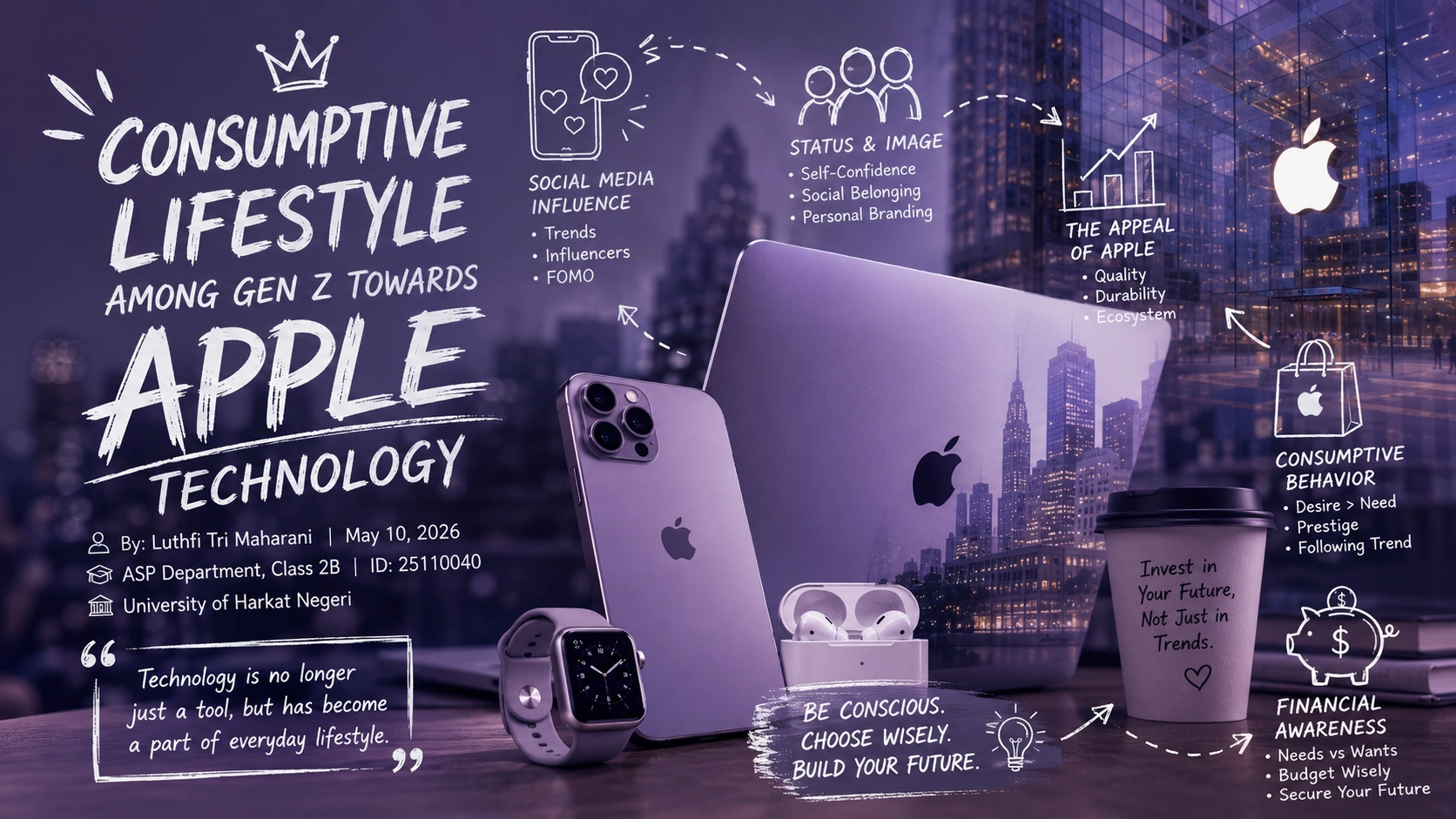

By: Luthfi Tri Maharani | May 10, 2026 | ASP Department, Class 2B | ID: 25110040
University of Harkat Negeri
Have you ever seen a friend who immediately upgraded his iPhone as soon as the new series came out? Or even willing to save for a long time just to buy products from Apple? If so, you are certainly not alone. This phenomenon is already very common among Gen Z and is happening almost everywhere from university hallways to coffee shops, from social media feeds to everyday conversations. Technology is no longer just a tool for getting things done. For this generation, it has become a deeply embedded part of everyday lifestyle and personal identity.
Every time Apple announces a new product launch, the internet erupts. Social media timelines flood with reactions, reviews, and unboxing videos within hours. Pre-orders sell out in minutes. And among the most enthusiastic buyers are young people students, fresh graduates, and early career professionals who make up the heart of Generation Z. The question that naturally follows is: why? Why does this generation feel such a strong pull toward Apple products, often beyond what their financial situation reasonably allows?
In my opinion, Gen Z’s consumptive lifestyle towards Apple products occurs due to the influence of the social environment, digital trends, and the desire to look “up-to-date.” These three forces do not work in isolation they reinforce one another, creating a powerful cycle that drives repeated purchasing behavior even when it is not financially wise.
“Technology is no longer just a tool, but has become a part of everyday lifestyle.”
The Role of Social Media
First, social media has a big role in shaping how Gen Z perceives and relates to Apple products. There is a lot of content across platforms like TikTok, Instagram, and YouTube that displays Apple products as something cool and a must-have. Tech influencers showcase their setups. Lifestyle creators film morning routines with AirPods in their ears. Aesthetic desk tour videos almost always feature a MacBook front and center.
Unconsciously, Gen Z follows because they want to look the same as what they see on the internet. The constant exposure to these images plants a subtle but persistent message: that Apple equals a certain kind of person creative, modern, successful, and desirable. In addition, Apple’s simple and elegant design is indeed easy to attract attention. The minimalist aesthetic of Apple products photographs beautifully, making them ideal props in the content-driven world Gen Z inhabits.
The algorithm, too, plays its part. Once a user interacts with Apple-related content even just pausing to watch for a few seconds the platform serves them more of the same. Over time, their entire feed becomes a steady stream of Apple content, quietly normalizing the idea that owning these products is simply what people like them do. What begins as passive consumption of content slowly turns into an active desire to purchase.
Status, Image, and Social Belonging
In addition to social media influence, owning Apple products is often considered to increase self-confidence. In certain social environments, using an iPhone or MacBook can give a modern and established impression. It signals that you are someone who is up-to-date, financially capable, and attuned to quality whether or not any of that is actually true.
Although it is not always needed, many still buy it to maintain their “image” in front of others. A student who cannot afford rent comfortably might still stretch their budget thin to buy the latest iPhone, because showing up with an outdated phone or worse, a non-Apple phone can feel socially costly in their peer group. This is not vanity in the simple sense. It is a deeply human response to the need for social belonging and acceptance.
Gen Z has grown up in an era where personal branding starts young. From the profile picture you choose to the products you are seen using, every detail contributes to how others perceive you and how you perceive yourself. Apple, with its powerful brand identity and loyal community, fits perfectly into this dynamic. Owning an Apple product does not just mean owning a device. It means becoming part of a tribe.
“Not all purchases are made because of necessity, but because of prestige or following the trend.”
The Case for Apple: Quality That Speaks for Itself
Indeed, it cannot be denied that Apple products have good quality and are durable. Many people buy Apple not because of social pressure, but because the performance is stable and the ecosystem is comfortable to use. The seamless integration between iPhone, MacBook, iPad, and other Apple devices creates an experience that is genuinely hard to replicate with other brands.
For a designer who works across multiple devices, a student who needs reliable performance for demanding software, or a professional who values long-term investment over frequent replacements Apple products can be a genuinely rational choice. The hardware is well-built, the software updates are consistent, and the resale value remains higher than most competitors. These are real advantages that deserve acknowledgment.
But on the other hand, we also have to be honest: not all purchases are made because of necessity. A significant portion of Apple buyers especially among Gen Z are motivated by prestige or following the trend rather than by a clear, practical need. And it is this segment of purchasing behavior that raises serious questions about financial health and decision-making priorities.
A Call for Conscious Living
In the end, there is nothing wrong with liking Apple products. Admiring good design, appreciating reliable technology, and enjoying a well-built ecosystem are all perfectly reasonable. The problem only arises when desire outpaces financial reality when the pursuit of an image leads to decisions that hurt your wallet, your savings, and ultimately your future.
However, it is important for Gen Z to be more conscious in managing finances and to learn to distinguish between needs and desires. Before making a big purchase, it is worth pausing to ask: Do I genuinely need this right now? Will this improve my life in a meaningful way? Or am I buying this because I feel like I should because everyone else seems to have it, because I want to fit in, because I am afraid of missing out?
Don’t let a consumptive lifestyle harm yourself in the future. Financial freedom, the ability to handle emergencies, to invest in your growth, and to build a stable life these are worth far more than any gadget. Being truly up-to-date in the most important sense means staying informed, staying wise, and making choices that serve your long-term wellbeing, not just your short-term image.

⚡ Baca Lebih Cepat Artikel MMI di Ponsel Anda!
Ikuti Channel WhatsApp
Media Mahasiswa Indonesia (MMI):
KLIK DI SINI