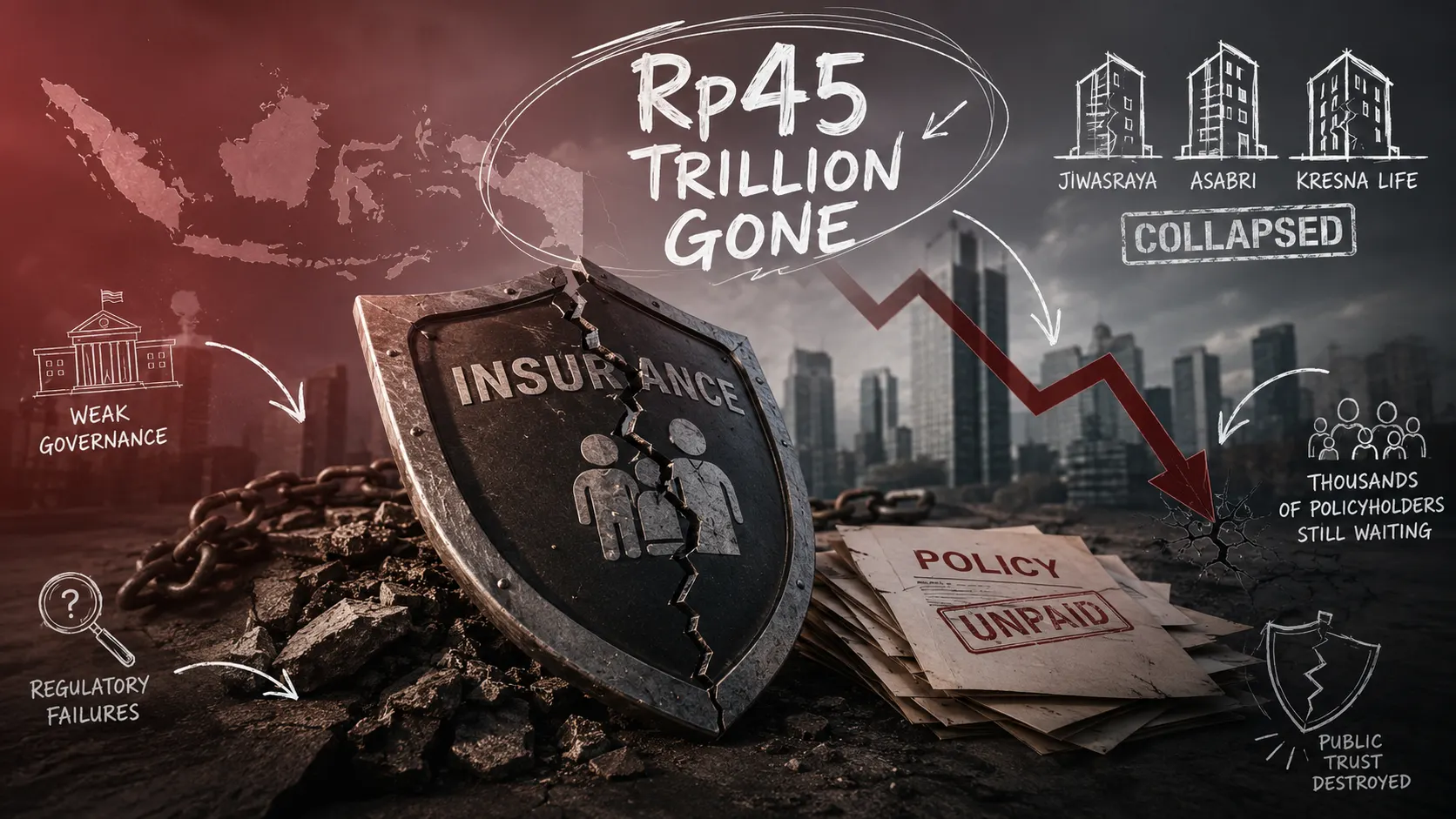

Bekasi, MMI — More than Rp45 trillion has disappeared, three of Indonesia’s largest insurance companies have collapsed under the weight of financial misconduct, and thousands of policyholders are still waiting for the protection they were once promised. The downfall of Jiwasraya, ASABRI, and Kresna Life has evolved into one of the country’s most significant financial scandals, exposing not only corporate failures but also serious weaknesses in governance and regulatory oversight that have undermined public confidence in Indonesia’s insurance industry.
Although each case unfolded under different circumstances, investigators uncovered strikingly similar patterns. Jiwasraya and ASABRI suffered enormous losses from problematic investment decisions, while Kresna Life failed to meet its obligations after concentrating investments in illiquid affiliated assets. Collectively, the three cases resulted in more than Rp45 trillion in losses and affected policyholders ranging from retired military personnel to ordinary Indonesian families.
Beyond the financial damage, the scandals revealed systemic weaknesses in corporate governance, investment oversight, and financial supervision that continue to challenge the credibility of Indonesia’s insurance sector.
Understanding Three Major Insurance Cases in Indonesia: When Public Trust Is Put to the Test
In recent years, Indonesia’s insurance industry has faced a crisis of confidence due to cases involving PT Asuransi Jiwasraya (Persero), PT ASABRI (Persero), and PT Asuransi Jiwa Kresna (Kresna Life). Although each case has distinct characteristics, all three demonstrate how weak governance and financial management can affect millions of policyholders and participants.
Jiwasraya’s problems began to surface after the company launched the JS Saving Plan in 2009, a product promising high returns. The company’s financial condition continued to deteriorate due to risky investments and alleged financial statement manipulation, reaching a critical point in 2018 when the company defaulted on its obligations to policyholders.
An investigation by the Attorney General’s Office later uncovered alleged corruption in investment management. The government, together with the Financial Services Authority (OJK), subsequently restructured the policies through IFG Life before Jiwasraya’s business license was revoked in 2025.
Public attention then shifted to PT ASABRI (Persero), where the Attorney General’s Office uncovered alleged irregularities in the management of the company’s investment funds. Participant funds were allegedly invested in high-risk instruments, resulting in estimated state losses of Rp22–23.7 trillion.
Although the company did not experience a payment default similar to Jiwasraya, the case raised significant public concern because it involved pension and social security funds belonging to TNI soldiers, Polri officers, and civil servants within the Ministry of Defense. The recurring pattern of risky investment practices further strengthened concerns over governance within Indonesia’s insurance sector.
Baca Juga: Application of the ARIMA Model: Life and Non-Life Indonesian Insurance Companies Asset’s Forecasting
Attention later turned to the private insurance sector when Kresna Life faced difficulties in paying claims to policyholders in 2020. Despite restructuring efforts and intensive supervision by the OJK, the company failed to restore its financial condition and ultimately had its business license revoked in June 2023. The decision was subsequently upheld through legal proceedings, marking the end of the company’s operations.
Taken together, these three cases reveal a common pattern: financial and governance problems that developed over many years before escalating into full-scale crises. Their consequences extended beyond the companies themselves, undermining public confidence in Indonesia’s insurance industry.
Ultimately, the Jiwasraya, ASABRI, and Kresna Life cases serve as a reminder that good corporate governance, transparency, and effective regulatory oversight are fundamental to ensuring the long-term sustainability of the country’s insurance sector.
The Causes
Jiwasraya’s troubles date back further than most people realize. Its equity was already negative Rp3.92 trillion in 2006, prompting accounting manipulation that earned it a disclaimer from the state auditor (BPK) for 2006–2007.
A major trigger came with the JS Saving Plan, a bancassurance product promising a fixed annual return of 9–13% with yearly withdrawal rights, well above prevailing deposit and bond rates. This created two fatal mismatches: a rate mismatch between the fixed returns promised to customers and the volatile equity or mutual fund investments funding them, and a tenor mismatch between long-term, illiquid holdings and a product redeemable every year.
The numbers illustrate the unraveling. Mutual fund investments fell from Rp19.17 trillion in 2017 to Rp6.64 trillion in 2019, equity holdings declined from Rp6.63 trillion to Rp2.48 trillion, and deposits dropped from Rp4.33 trillion to Rp0.8 trillion.
Management also engaged in window dressing to conceal the deficit, while several studies have pointed to political interference in board appointments and portfolio decisions. Incoming CEO Hexana Tri Sasongko revealed in 2018 that the reported 2017 profit of approximately Rp2.5 trillion actually shrank to about Rp360 billion after premium-reserve adjustments.
Prosecutors later linked the collapse to stock-manipulation schemes involving Benny Tjokrosaputro, with state losses estimated at Rp16.8 trillion. The OJK revoked Jiwasraya’s license on January 16, 2025, after its policies had been restructured and transferred to IFG Life.
ASABRI, the social insurer for military, police, and defense and police ministry personnel, followed a strikingly similar pattern despite managing pension and severance funds rather than a retail investment product.
The BPK found systemic fraud in ASABRI’s investment management from 2012 to 2019. Directors allegedly colluded with outside parties to purchase stocks with weak fundamentals and conducted repeated trades through nominee accounts to artificially inflate prices. This made the investment portfolio appear healthy while effective control remained with private parties. The BPK calculated state losses at Rp22.78 trillion.
Baca Juga: Pentingnya Clinical Trial Insurance sebagai Bentuk Perlindungan Hukum bagi Relawan Uji Klinik
Unlike the two state-owned cases involving corruption allegations, Kresna Life’s failure was primarily a prudential breakdown. In May 2020, management blamed pandemic-related force majeure for its liquidity crisis, delaying K-LITA and PIK policy payouts for a full year—far longer than the six months initially promised.
The OJK’s examination found deeper problems. Investments were heavily concentrated in stocks affiliated with the Kresna Group itself, while liabilities were understated, making the company’s Risk-Based Capital (RBC) ratio appear healthier than it actually was.
Under POJK 71/2016, as amended by POJK 4/2023, insurers are required to maintain an RBC ratio of at least 120% of the Minimum Risk-Based Capital. Kresna Life failed to meet this threshold, while neither fresh capital from its controlling shareholder nor a proposed subordinated-loan conversion materialized.
Delayed claims reached approximately Rp5.2 trillion, affecting around 4,500 individual policyholders and 81 group policies. The OJK revoked the company’s license on June 23, 2023, and issued a Written Order requiring the controlling shareholder and named directors to personally cover the losses. Following a court challenge, the Supreme Court upheld the license revocation in 2025.
Across all three cases, a common pattern emerges: promised returns did not match the risks actually taken, funds were concentrated in high-risk, illiquid, or related-party assets, and governance and institutional independence were weak.
High-risk investment was an immediate trigger in all three cases, but it was not the sole cause, as risk-taking itself is not inherently wrong in the insurance business. The deeper issue was a mismatch between the risk profile of investments and the guarantees made to customers, compounded by a lack of transparency and weak risk controls.
As a result, critical decisions were made outside proper approval channels, while the companies’ true financial conditions were concealed from regulators and the public.
Why was Oversight Ineffective? When Crises are Only Recognized After Losses Have Mounted
The Jiwasraya, ASABRI, and Kresna Life scandals demonstrate that weak oversight was one of the key factors that exacerbated the crisis in Indonesia’s insurance industry. These three cases exhibit a similar pattern: delayed risk detection, suboptimal coordination, and regulatory action taken only after the companies’ conditions had already deteriorated.
Jiwasraya’s problems had emerged long before its default in 2018. At the time, supervision still relied heavily on company reports through self-reporting mechanisms, focusing more on administrative compliance than on the company’s actual financial condition and investment quality.
In addition, a risk-based supervision approach had not yet been fully implemented. Many of the underlying problems also arose before the OJK assumed responsibility for supervising the financial services sector in 2013.
The ASABRI case further illustrates how ineffective oversight can stem from complex institutional arrangements. The involvement of multiple agencies—including the Ministry of State-Owned Enterprises, the Ministry of Defense, the state auditor, and law enforcement authorities—created coordination challenges that delayed the detection of alleged investment irregularities.
Baca Juga: Daftar Perusahaan Fintech Terbesar di Indonesia yang Terdaftar di OJK
As a result, high-risk investment practices continued for several years before they were uncovered. This case highlights the importance of an integrated oversight system supported by effective information sharing and coordination among supervisory institutions.
A different challenge emerged in the Kresna Life case. After the company experienced difficulties paying claims in 2020, it was placed under special supervision by the OJK and given an opportunity to improve its financial condition and comply with RBC requirements.
However, the company failed to restore its financial health, leading to the revocation of its business license in 2023. This case demonstrates that supervisory intervention initiated only after a company has entered a crisis phase has limited effectiveness in restoring financial stability.
Taken together, these three cases reveal that Indonesia’s insurance supervision system at the time remained largely reactive. Heavy reliance on company reports, limited implementation of risk-based supervision, and weak interagency coordination all contributed to the severity of the crises.
In response, the OJK has strengthened Risk-Based Supervision (RBS), enhanced coordination among relevant authorities, and developed an early-warning system to identify potential risks before they escalate into crises that could undermine public confidence in the insurance industry.
What Role does the OJK Play in Handling the Three Major Insurance Cases in Indonesia?
The Jiwasraya, ASABRI, and Kresna Life cases have posed a major challenge for the Financial Services Authority (OJK) as the regulator of Indonesia’s insurance industry.
Under Law No. 21 of 2011 on the Financial Services Authority (OJK), and further reinforced by Law No. 4 of 2023 on the Development and Strengthening of the Financial Sector (P2SK), the OJK has the authority to regulate and supervise the financial services sector, including the insurance industry. These powers are exercised through various supervisory policies, consumer protection measures, and enforcement actions against troubled companies.
Following Jiwasraya’s default in 2018, the OJK, together with the government and the Ministry of State-Owned Enterprises, oversaw the restructuring of insurance policies through the establishment of IFG Life as the recipient of transferred policies.
This initiative was intended to protect policyholders’ rights while maintaining the stability of the insurance industry. The OJK also coordinated with the Attorney General’s Office throughout the investigation process and ultimately revoked Jiwasraya’s business license after the settlement process had been completed.
The focus then shifted to ASABRI, whose insurance programs serve members of the Indonesian National Armed Forces (TNI), the National Police (Polri), and civil servants within the Ministry of Defense.
Given the involvement of multiple government institutions, the OJK played an important coordinating role alongside the Ministry of State-Owned Enterprises, the Supreme Audit Agency (BPK), and law enforcement authorities. The case also prompted the OJK to evaluate and strengthen the implementation of Good Corporate Governance (GCG), risk management, and investment transparency across the insurance sector.
Baca Juga: Meneropong Sejarah hingga Eksistensi Asuransi Syariah di Indonesia
A more direct supervisory role was evident in the Kresna Life case. After the company encountered difficulties in paying claims in 2020, the OJK placed it under special supervision and provided an opportunity to restore its financial condition in accordance with RBC requirements.
However, because the company failed to meet the required solvency standards, the OJK revoked its business license in June 2023, a decision that was subsequently upheld through legal proceedings.
Taken together, these three cases demonstrate that the OJK’s performance remains subject to evaluation. While its oversight has been criticized for failing to detect problems at an earlier stage, the regulator nevertheless played an important role in limiting the impact of the crises through policy restructuring, interagency coordination, intensive supervision, and the revocation of business licenses for companies that no longer met regulatory requirements.
The lessons learned from Jiwasraya, ASABRI, and Kresna Life have encouraged the OJK to strengthen Risk-Based Supervision (RBS), enhance Good Corporate Governance (GCG) standards, tighten investment oversight, and improve policyholder protection as part of broader efforts to rebuild public confidence in Indonesia’s insurance industry.
The Reforms
One of the most direct regulatory responses to the Jiwasraya case was POJK 43/2019, which amended POJK 73/2016 on Good Corporate Governance. The regulation required insurers to strengthen their compliance functions by assigning responsibility to an appropriate director or board-level officer independent from technical, financial, and marketing roles.
The OJK later provided greater flexibility by allowing a sub-director-level compliance officer and permitting the compliance function to be combined with risk management. Even so, by February 2020, only 25 of 130 registered insurers had appointed a compliance director.
The OJK also sanctioned 37 investment managers and three public accountants for their roles in enabling or failing to identify reporting irregularities associated with the scandal.
Because the ASABRI and Jiwasraya cases were prosecuted in parallel and shared several defendants, regulators and law enforcement authorities largely treated them as a combined trigger for reform. This led to calls for stricter asset-placement rules, closer scrutiny of related-party and nominee-account transactions, and greater accountability for investment managers involved in enabling market manipulation.
Indonesia’s Judicial Commission explicitly framed the combined Rp16.8 trillion and Rp22.78 trillion losses as momentum for strengthening asset recovery and prevention across state financial institutions.
Kresna Life’s collapse, meanwhile, was primarily treated as a prudential-supervision failure rather than a criminal case at its origin. The regulatory response therefore differed. Its license revocation was carried out under POJK 71/2016, as amended by POJK 4/2023, alongside a Written Order under POJK 18/2022.
The OJK’s handling of the case under the 2023 Financial Sector Development and Strengthening Law, known as UU P2SK, was viewed as prioritizing restorative and consumer-protection measures, in contrast to the more punitive approach previously taken against Wanaartha Life under the 2014 Insurance Law.
Taken together, these reforms strengthen supervision on several fronts. Mandatory compliance functions can help identify conflicted decisions earlier, while the RBC framework provides the OJK with a measurable trigger for intervention before insolvency.
Baca Juga: Meneropong Sejarah hingga Eksistensi Asuransi Syariah di Indonesia
The ASABRI and Jiwasraya prosecutions also extended accountability beyond insurer management to investment managers, accountants, and market intermediaries. Meanwhile, the new Policy Guarantee Program introduces a funded safety net that was unavailable during the earlier failures of these insurers.
Indonesia is also shifting toward a new Risk-Based Capital regime, moving closer to international standards such as the European Union’s Solvency II framework. As of June 2026, industry-wide RBC reportedly stood at 476.11% for life insurance and 311.74% for general insurance, both well above the 120% minimum.
Governance reforms also include strengthening the actuarial function and adopting PSAK 117, aligned with IFRS 17. This changes how insurance liabilities and profits are recognized and is intended to improve the transparency of financial reporting.
Investment oversight has also tightened on two fronts. On the capital-market side, sanctions against investment managers and accountants extend accountability to financial intermediaries rather than focusing solely on insurer management. On the prudential side, concentration and related-party risks are increasingly addressed through risk-based supervision.
One of the most significant reforms for policyholders is the Policy Guarantee Program. Under the relevant legislation, insurance and sharia insurance companies are required to participate in the program, while the guarantee body can collect premiums, periodic contributions, and an initial participation fee.
The program is designed to guarantee some or all policyholder rights when an insurer is placed under resolution. However, it covers only the protection component of an insurance policy rather than its investment component, an important distinction for blended products such as the JS Saving Plan or K-LITA.
Lessons Learned
One lesson consistently emerges from both academic research and regulatory reviews: major financial failures rarely occur overnight. They are often preceded by weak corporate governance, ineffective risk management, and inadequate oversight.
Research published in the Diponegoro Law Journal found that the Jiwasraya case reflected serious violations of Good Corporate Governance (GCG) principles, particularly accountability, transparency, and responsibility. These governance failures enabled high-risk investment decisions to continue unchecked until they eventually resulted in significant financial losses.
Similar governance weaknesses were later observed in both ASABRI and Kresna Life, where conflicts of interest, poor investment controls, and insufficient internal monitoring undermined the companies’ financial stability.
For insurance companies, the scandals demonstrate that governance cannot simply exist as a compliance checklist. Strong internal controls, independent oversight, prudent investment management, and an effective whistleblowing mechanism are essential to identifying misconduct before it develops into a crisis.
Baca Juga: Resolving PBI Deactivation Issues Through PBI System Integration Solutions
Recent legal scholarship has likewise emphasized that stronger institutional supervision and better coordination among regulators are critical to preventing governance failures within state-owned insurers.
The regulator has also begun introducing structural reforms. Following the enactment of the Financial Sector Development and Strengthening Law (UU P2SK), the Financial Services Authority (OJK) has accelerated initiatives including a new risk-based capital framework, stronger actuarial supervision, improvements to insurance resolution mechanisms, and greater use of digital technology to support supervisory functions.
These reforms have been viewed positively by the Organisation for Economic Co-operation and Development (OECD), which considers stronger financial governance an important component of Indonesia’s institutional development.
Consumers, however, also play an important role in strengthening the industry’s resilience. Many policyholders continue to misunderstand insurance products, particularly those combining protection with investment features.
Financial experts therefore encourage the public to verify an insurer’s license through the OJK, understand the risks associated with investment-linked policies, and remain cautious of promises offering unusually high returns. Improving financial literacy is increasingly viewed as one of the most effective forms of consumer protection, complementing regulatory oversight rather than replacing it.
Closing
The stories of Jiwasraya, ASABRI, and Kresna Life serve as a reminder that trust is the most valuable asset in the insurance industry. Restoring that trust requires more than legal prosecution after losses have occurred. It demands transparent corporate governance, proactive supervision by regulators, and informed consumers who understand the products they purchase.
While Indonesia has begun implementing significant regulatory reforms, their true success will ultimately be measured not by the number of new rules introduced, but by whether they prevent future policyholders from experiencing the same losses.
Until governance, supervision, and financial literacy improve together, public confidence in the insurance sector will remain a work in progress.
Penulis:
1. Inayat Anggun Mawaddah
2. Rahajeng Justica Syahla Pranoto
3. Claudia Meta Tasya Cikita
4. Erika Enjelina Simanjuntak
5. Alya Aniqotul Fikria
Mahasiswa Hukum President University
Editor: Ika Ayuni Lestari
Bahasa: Rahmat Al Kafi
References
• Financial Services Authority (OJK). Insurance Sector Supervision and Financial Sector Development and Strengthening Law (UU P2SK). (ojk.go.id)
• Indonesian Supreme Audit Agency (BPK RI). Audit Reports on PT Asuransi Jiwasraya and PT ASABRI. (bpk.go.id)
• Situmorang, S., Saptono, H., & Mas’ut, M. (2021). Tanggung Jawab Direksi PT Asuransi Jiwasraya (Persero) Terkait Kerugian BUMN Berdasarkan Prinsip Good Corporate Governance. Diponegoro Law Journal, 10(2).
• CNN Indonesia. (2020, January 8). Kronologi kasus Jiwasraya gagal bayar hingga dugaan korupsi.
• CNN Indonesia. (2020, August 14). Kronologi kasus asuransi jiwa Kresna Life hingga dihukum OJK.
• CNBC Indonesia. (2021, February 2). Lebih gede dari Jiwasraya, ini kronologis mega skandal ASABRI.
• CNBC Indonesia. (2024, February 26). OJK siapkan banding, ini kronologi kasus Kresna Life.
• CNBC Indonesia. (2025, February 21). Kronologi kasus mega korupsi Jiwasraya hingga akhirnya ditutup OJK.
• Garuda Kemdikbud. (2024). Peran OJK sebagai badan pengawas terhadap fenomena gagal bayar polis asuransi di Indonesia.
• Kejaksaan Agung Republik Indonesia. (n.d.). Perkembangan penanganan perkara Jiwasraya dan ASABRI.
• Kompas.com. (2021, February 3). Ini kronologi korupsi ASABRI yang merugikan negara Rp23,7 triliun.
• Kompas.com. (2023, June 27). Kronologi kasus Kresna Life sebelum pencabutan izin usaha.
• Kompas.com. (2025, February 10). Kronologi kasus Jiwasraya, salah satu korupsi terbesar di Indonesia.
• Ombudsman Republik Indonesia. (n.d.). Ombudsman soroti lemahnya pengawasan industri keuangan.
• Otoritas Jasa Keuangan. (2023). Roadmap pengembangan dan penguatan perasuransian Indonesia 2023–2027.
• Otoritas Jasa Keuangan. (2023). OJK berkomitmen menyelesaikan permasalahan industri asuransi dan meningkatkan pelindungan konsumen.
• Otoritas Jasa Keuangan. (2024). Satu dasawarsa OJK mengabdi untuk negeri: Menjalin integrasi, menganyam integritas.
• Otoritas Jasa Keuangan. (2025). Laporan hasil rapat Dewan Komisioner Bulanan Februari 2025.
• ANTARA News Jambi. (2021, February 2). Kronologi kasus korupsi ASABRI dijelaskan oleh Kejagung.
• BPK RI. Kerugian Negara Kasus PT ASABRI Rp22,78 Triliun.
• Kompas.com. Ketua BPK: Kerugian Negara dalam Kasus Korupsi ASABRI Rp22,78 Triliun.
• Tempo.co. Jaksa Agung Ungkap Kerugian Kasus ASABRI Rp22,78 Triliun.
• AFU.id. Kilas Balik Kasus Korupsi ASABRI.
• OJK. Pencabutan Izin Usaha Kresna Life serta Pemberian Perintah Tertulis.
• CNBC Indonesia. Breaking News: OJK Cabut Izin Usaha Kresna Life.
• CNN Indonesia. Alasan OJK Cabut Izin Asuransi Kresna Life.
• Kontan.co.id. MA Kabulkan Permohonan Kasasi OJK Terkait Kresna Life.
• ICOPI. Tata Kelola Perusahaan Asuransi, Studi Kasus: Gagal Bayar PT Asuransi Jiwasraya.
• IRMAPA. PT Asuransi Jiwasraya – Kegagalan Pengelolaan Risiko Investasi.
• SmartLegal.id. Asuransi Jiwasraya Resmi Ditutup.
• UNIKOM. Mega Skandal PT Asuransi Jiwasraya.
• Jurnal Ekonomi Revolusioner, Vol. 8 No. 5 (2025). Analisis intervensi politik dalam pengangkatan direksi Jiwasraya.
• Hukumonline. Perusahaan Asuransi Tak Wajib Miliki Direktur Kepatuhan.
• Kompas.com. OJK Bolehkan Direktur Kepatuhan Perusahaan Asuransi Rangkap Jabatan.
• Kompas.com. OJK: Baru 25 Perusahaan Asuransi yang Memiliki Direktur Kepatuhan.
• Kontan.co.id. Beleid OJK terbit, asuransi wajib punya direktur kepatuhan demi perkuat tata kelola.
• Detik Finance. OJK Cabut Izin Kresna Life, Ada Peluang buat PKPU.
• Kontan.co.id. Perubahan UU P2SK Terbit, LPS Jamin Polis Asuransi Lewat Program Penjaminan Polis.
• Kontan.co.id. Ini Kata AAUI soal Dampak Iuran Penjaminan Polis bagi Industri Asuransi.
• Kontan.co.id. Perubahan UU P2SK Atur LPS Jamin Polis, Ini Respons Maximus Insurance.
• IDX Channel. OJK Sebut Program Penjaminan Polis Perkuat Perlindungan Masyarakat di Industri Asuransi.
• Kontan.co.id. OJK Jalankan Berbagai Reformasi Struktural di Sektor Asuransi dan Dana Pensiun.
• Republika.id. Kasus ASABRI-Jiwasraya Jadi Momentum.

⚡ Baca Lebih Cepat Artikel MMI di Ponsel Anda!
Ikuti Channel WhatsApp
Media Mahasiswa Indonesia (MMI):
KLIK DI SINI















what a great article🤍
very interesting
so insightful
Well written! Clear, insightful, and easy to follow
Good.
WAHH🤩
waah sangat membantu sekali💪
cool!!!
tbh, this article so inspiring😩💓
so insightful and well written!!🤍