
Data shows that between 11 million and 13.5 million BPJS Health PBI (Premium Assistance Recipients) participants have been deactivated by the government. This has resulted in many BPJS Health PBI participants being turned away by hospitals on the grounds that their BPJS Health coverage is inactive. Consequently, affected participants are unable to access adequate health services.
After receiving numerous public complaints regarding the deactivation, the government initiated a reactivation process for affected BPJS Health PBI participants.
The Impact of PBI BPJS Health Deactivation
In my opinion, the government’s deactivation of the BPJS Health PBI program has had a significant impact on its participants, especially those who are genuinely unable to afford healthcare. The BPJS Health PBI program was established to ensure access to healthcare for the public, particularly vulnerable communities who face limitations in their quality of life and require special protection or assistance from the government.
However, if the BPJS Health PBI program is deactivated in this manner, how can the health of vulnerable communities be guaranteed? Many participants are being turned away by hospitals because their BPJS Health coverage is inactive. As a result, they are unable to obtain the healthcare services they need.
Also Read: Pentingnya Pembenahan Data dan Transparansi Pemerintah terhadap Permasalahan BPJS PBI
The scale of the deactivation also demonstrates the seriousness of the issue. In 2025, approximately 7.3 million participants had their BPJS Health coverage deactivated. By early 2026, this number had increased to between 11 million and 13.5 million participants.
These figures indicate a continuous increase from 2025 to 2026 and show that the deactivation is not merely an administrative issue but a serious problem with the potential to significantly affect public access to health insurance.
As the number of deactivations increased, the government initiated a reactivation process. It successfully reactivated 2.1 million participants, while approximately 2 million participants were determined to be financially capable of paying their own health insurance contributions. Meanwhile, data for around 5 million participants was not included in the new database.
Economic Consequences of Deactivation
The deactivation of the BPJS Health PBI program may also create broader economic consequences.
First, it can impose a heavy financial burden on vulnerable communities. Individuals who are already struggling to meet their daily living expenses must also bear the cost of healthcare independently, further increasing their financial hardship.
Second, it may contribute to rising poverty rates. The additional burden of medical expenses has the potential to push economically vulnerable households deeper into poverty.
Also Read: Tingkat Kemiskinan di Indonesia, Sebuah Tantangan yang Harus Dituntaskan
Data Integration Problems
The deactivation occurred following the transition from the Integrated Social Welfare Data (DTKS) to the National Socioeconomic Data (DTSEN). This data migration was intended to improve the accuracy of BPJS Health PBI assistance by ensuring that government support is distributed more effectively.
However, the transition caused many previously active participants to become inactive. During the migration process, some existing records were altered or lost, resulting in inaccurate participant data.
Consequently, many eligible individuals lost access to adequate healthcare coverage. Therefore, the government should carefully consider the potential consequences of future data transitions and develop long-term solutions to prevent similar problems from recurring.
PBI Data Integration System as a Solution
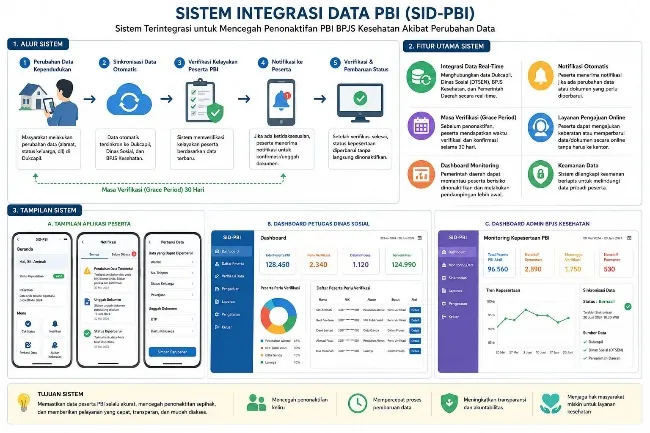
The government can develop a more effective population data management system through a BPJS Health PBI Data Integration System.
This system would integrate data from local governments, social services agencies, BPJS Health, and population registration agencies in real time. It would include an automatic synchronization feature so that any changes in participant data are immediately updated across all relevant institutions.
The system could also provide notification services via SMS or WhatsApp whenever participant data changes or requires correction.
Another important feature is a verification period. For example, if a participant’s BPJS Health PBI status is scheduled for deactivation within 30 days, the participant would have the opportunity to submit supporting documents to verify continued eligibility before the deactivation takes effect.
A dashboard monitoring feature would enable local governments to identify participants at risk of deactivation and take proactive measures before coverage is terminated.
Finally, an online portal for complaints and data updates would allow participants to submit corrections electronically without having to visit multiple government offices.
System Workflow and Benefits
The proposed system follows a straightforward workflow.
First, participants submit or update their information through an online platform. The data is then automatically synchronized with the Civil Registry and Population Administration (Dukcapil), the Social Services Agency, and BPJS Health.
Next, the system verifies both the participant’s information and their eligibility for the BPJS Health PBI program. If inconsistencies are detected, participants receive notifications requesting confirmation or correction of their data.
After the verification process is completed, participant status is automatically updated without unnecessary deactivation.
This system offers several important advantages. It can reduce errors in participant deactivation, accelerate the data updating process, improve transparency by allowing participants to understand the reasons behind any status changes, reduce queues at BPJS Health and social services offices, and ensure that eligible low-income citizens continue to receive appropriate healthcare coverage.
Conclusion
The deactivation of BPJS Health PBI coverage is not a routine administrative matter. It has affected millions of people, preventing many eligible participants from accessing the healthcare services to which they are entitled.
Although the deactivation is part of the government’s effort to improve the targeting of BPJS Health PBI assistance, significant problems have emerged during the data transition process.
Therefore, implementing a BPJS Health PBI Data Integration System can provide a sustainable solution. Through integrated, real-time, and transparent data management, the process of updating participant information can become faster, more accurate, and more accountable. Ultimately, the primary objective of the BPJS Health PBI program—ensuring equitable access to healthcare for vulnerable communities—can be achieved more effectively.
Writer: Syifa Aulia Maharani
Student of the Public Sector Accounting Study Program, Harkat Negeri University
Editor: Nilam Indahsari
Language Editor: Rahmat Al Kafi
⚡ Baca Lebih Cepat Artikel MMI di Ponsel Anda!
Ikuti Channel WhatsApp
Media Mahasiswa Indonesia (MMI):
KLIK DI SINI