
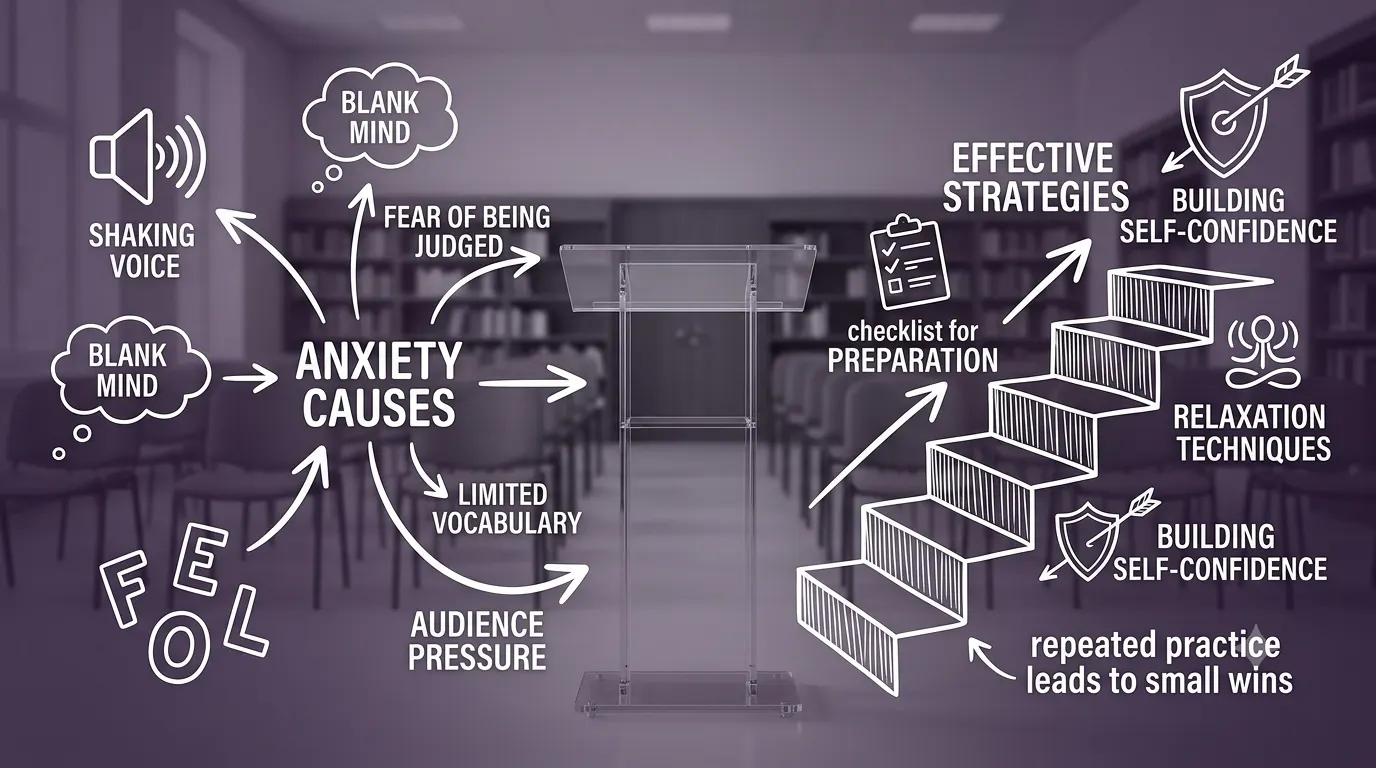

Picture this: a university student has spent the whole night rehearsing a presentation, has every line memorized, and knows the material better than anyone else in the room. Yet the moment they are asked to stand up and speak in English, their voice shakes, their mind goes blank, and words that felt so natural in front of the mirror suddenly refuse to come out right.
It’s tempting to read this as a lack of preparation or a lack of talent, but for millions of English as a Foreign Language (EFL) learners, this is simply what it feels like to speak a second language out loud in front of other people. It is far more common, and far more explainable, than most students realize.
Why Speaking a Foreign Language in Public Feels Different
There is a reason this kind of nervousness feels different from ordinary stage fright. When psychologist Elaine Horwitz and her colleagues introduced the concept of foreign language classroom anxiety in the 1980s, they argued that this anxiety is not merely general nervousness borrowed from other situations, but a distinct emotional response tied specifically to the experience of learning and using another language.
Their Foreign Language Classroom Anxiety Scale drew on three related ideas, namely communication apprehension, test anxiety, and fear of negative evaluation, though Horwitz was careful to note that foreign language anxiety is more than simply the sum of these three. It has its own character, shaped by the very act of trying to express yourself in words that are not fully your own.
This helps explain something many EFL students find confusing about themselves: why a student who writes fluent English essays and scores well on grammar tests can still freeze the moment they have to speak that same language in front of classmates. Competence on paper and confidence out loud are simply not the same thing, and research on foreign language anxiety has spent decades trying to understand the gap between them.
What Actually Causes It
Studies conducted with EFL and ESL university students across different countries, from Vietnam and Indonesia to Pakistan and Thailand, tend to point toward a similar cluster of causes, even though the students, classrooms, and cultures involved are all different.
The fear of being judged sits at the center of almost every study on this topic. Students describe worrying less about the content of what they are saying and more about how their pronunciation, grammar, or accent will be perceived by classmates and lecturers.
This matches Horwitz’s original notion of fear of negative evaluation, and it shows up again and again in more recent research on university-level EFL classrooms, where students openly describe the discomfort of being watched and assessed while still learning.
Closely tied to this is the simple reality of limited vocabulary and language proficiency. A recent study among English Education students in Indonesia found a strong negative relationship between speaking anxiety and academic performance, and traced much of that anxiety back to a familiar trio: fear of negative evaluation, limited vocabulary, and low self-confidence.
In practice, this often means a student knows exactly what they want to say in their first language, but the English words simply are not there yet in the moment they need them, and that gap itself becomes a source of panic.
Preparation, or the lack of it, plays a similarly large role. Research on public speaking classes has found that an absence of preparation, references, and vocabulary is one of the clearest predictors of anxiety before students even step up to speak.
A related study on EFL students in online learning environments found that an unfamiliar topic was consistently the most dominant source of anxiety, both while preparing and right before performing. In other words, anxiety often starts long before the actual speech, in the quiet moments of not feeling ready.
Finally, audience pressure adds another layer. How familiar the audience is, how they will assess the performance, and how high the stakes feel all shape the intensity of the anxiety, a pattern that lines up with McCroskey’s long-standing framework on public speaking anxiety and continues to appear in newer studies on EFL classrooms today.
What Genuinely Helps
The encouraging part of this research is that public speaking anxiety among EFL students is not treated as a fixed trait. It is treated as something students can learn to manage, and several strategies show up consistently across studies.
Preparation, unsurprisingly, comes out on top. In a recent study on ESL learners, preparation was the most frequently chosen coping strategy, and it was also the most effective one, with the vast majority of students who used it reporting a real reduction in anxiety. Relaxation techniques followed closely behind as the second most common strategy, suggesting that calming the body often has to happen alongside preparing the mind.
Other research on EFL speaking anxiety identifies a slightly broader set of coping strategies, including changing one’s mindset toward the task, practicing relaxation, deliberately building self-confidence, and simply improving speaking skills through repeated practice.
None of these are quick fixes, but together they describe a fairly realistic path: students become less anxious not by eliminating nervousness entirely, but by getting more familiar with the feeling and building enough skill that it stops being overwhelming.
Repeated, lower-stakes practice also seems to matter more than students often expect. One study on university students found that exposure to more relaxed, less high-pressure speaking environments helped build the confidence needed to eventually face a full audience. This mirrors what many language teachers already suspect: confidence tends to grow through small, repeated wins rather than a single moment of courage.
Support from instructors matters too. In the same study, an overwhelming majority of participants agreed that their fear of public speaking could be overcome with proper counseling, instruction, and coaching. That is a meaningful finding, because it shifts some of the responsibility away from the individual student and toward the learning environment itself. Anxiety is not simply something students must white-knuckle through alone; it is something classrooms and teaching approaches can be designed to ease.
A Note for Students Who Recognize Themselves in This
If any of this feels familiar, it is worth remembering that this experience has been documented, studied, and explained across dozens of universities in different countries, not because those students were unprepared or incapable, but because speaking a foreign language out loud, in front of people who might judge every word, is genuinely one of the more vulnerable things a student is asked to do.
The anxiety is real, the causes behind it are well understood, and, according to the research, so is the way out. Preparation, practice, a shift in mindset, and a supportive classroom can turn what once felt paralyzing into something manageable, and eventually, into something closer to confidence.
Author: Muzayyanah
English Literature Student, Pamulang University
Also active as a member of the HRD division in the NUANZA BICARA organization
Editor: Salwa Alifah Yusrina
Bahasa: Rahmat Al Kafi
References
- Horwitz, E. K., Horwitz, M. B., & Cope, N. (1986). Foreign language classroom anxiety. As discussed in Foreign Language Anxiety and English Medium Instruction Classrooms: an Introduction, PMC. https://pmc.ncbi.nlm.nih.gov/articles/PMC9377287/
- Thirty years of public speaking anxiety research: topic modeling and semantic trend forecasting using LDA–Word2Vec integration. PMC (National Library of Medicine). https://pmc.ncbi.nlm.nih.gov/articles/PMC12592063/
- Public Speaking Anxiety (PSA): Causes and Classroom Strategies to Mitigate Anxiety among ESL Learners. International Journal of Research and Innovation in Social Science. https://rsisinternational.org/journals/ijriss/articles/public-speaking-anxiety-psa-causes-and-classroom-strategies-to-mitigate-anxiety-among-esl-learners/
- Investigating Public Speaking Anxiety Factors among EFL University Students through Online Learning. https://are.ui.ac.ir/article_26045.html
- Researching factors and coping strategies of EFL students’ speaking anxiety. Englisia: Journal of Language, Education, and Humanities. https://jurnal.ar-raniry.ac.id/index.php/englisia/article/view/22733
- Public Speaking Anxiety of University Students in EFL Context. https://www.researchgate.net/publication/367260909_Public_Speaking_Anxiety_of_University_Students_in_EFL_Context
- EFL Students’ Anxiety in Speaking English: Factors and Strategies. https://www.researchgate.net/publication/382007458_EFL_Students’_Anxiety_in_Speaking_English_Factors_and_Strategies
- The Study of EFL Students’ Public Speaking Anxiety and Academic Oral Presentation Strategies at a Tertiary Level in Thailand. Journal of Education and Innovation. https://so06.tci-thaijo.org/index.php/edujournal_nu/article/view/270538
Written by Muzayyanah, based on the studies cited above.

⚡ Baca Lebih Cepat Artikel MMI di Ponsel Anda!
Ikuti Channel WhatsApp
Media Mahasiswa Indonesia (MMI):
KLIK DI SINI