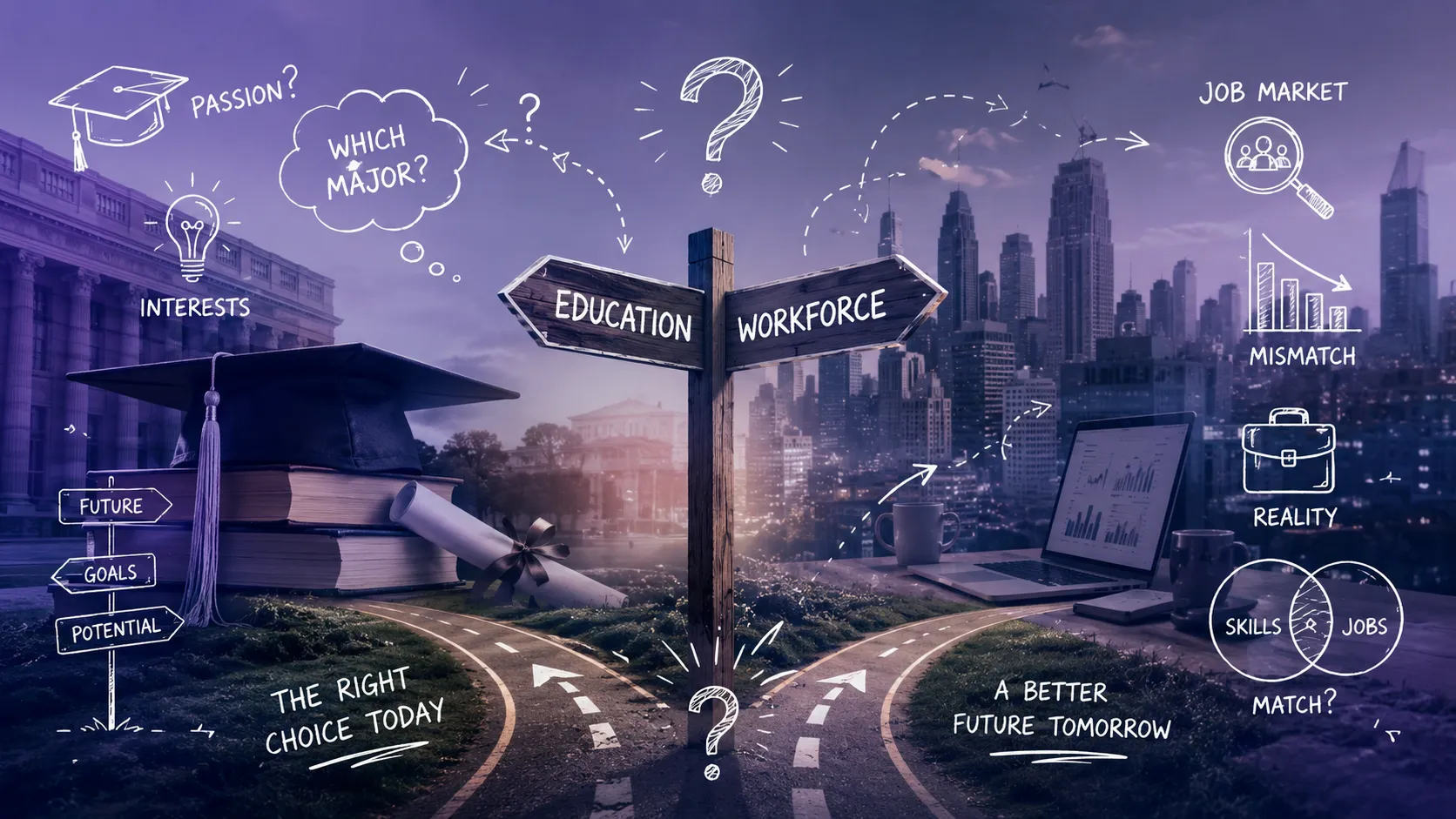

Pursuing higher education, such as at a university, can pave the way to a better life. College is a crucial phase in a person’s life journey, not only as a means to gain knowledge but also as a gateway to the professional world and a broader future.
However, behind this lies a phenomenon that haunts students currently in the midst of their studies: the issue of the major they have chosen. Students going through this phase often feel insecure, worrying that working in a field unrelated to their major would be deeply embarrassing.
According to data from the Indonesia Career Center Network (ICCN), 87% of Indonesian students feel they are in the wrong major. This figure is alarmingly high and indicates that the majority of students are not in a major that aligns with their passions. Beyond Indonesia, this issue is also widely faced around the world. Global data on mismatches, as reported in the journal article Field of Study Mismatch and Overqualification (IZA Journal of Labor Economics, 2017), indicates that 40% of graduates experience a mismatch between their field of study and their job, 11% work in a relevant field but are overqualified, and 13% work outside their field and are also overqualified.
Also Read: Analisis Pasar Tenaga Kerja dan Upah di Era Digital: Perspektif Ekonomi Manajerial
Meanwhile, a survey by Youthmanual found that 92% of high school students nearing graduation admitted to being unsure about choosing a major and planning their future. This data indicates that the issue of choosing the wrong major begins as early as high school. Academic mismatch (a mismatch between abilities or interests and the chosen major) is the most influential factor, affecting academic success and increasing the likelihood of taking longer to graduate.
Why Do Students Choose the Wrong Major?
This phenomenon is linked to the difficulty of finding employment, as many feel they chose the wrong major, and many college graduates end up working in fields unrelated to their majors. A survey conducted by ZipRecruiter of 1,500 college graduates preparing to apply for jobs found that many of them felt their chosen major was not worth it, particularly in terms of income.
This occurs due to a lack of guidance regarding students’ interests and talents, leaving them unaware of their own potential. This situation also causes those experiencing it to feel stressed due to pressure from family and society.
Based on this phenomenon, I believe that the high rate of students choosing the wrong major stems from an educational system that fails to help students recognize their potential and pursue appropriate academic paths. The difficulty graduates face in securing suitable jobs is a result of students selecting majors without developing their interests.
Also Read: Memperkuat Human Capital di Jawa Timur demi Kualitas SDM Berdaya Saing
Moreover, the issue of choosing the wrong major is not limited to students nearing graduation but begins as early as high school. Given this situation, many students feel confused about where to continue their studies and what major to pursue. Thus, this is not a new phenomenon occurring only at the higher education level.
A lack of awareness regarding one’s interests and talents is another contributing factor. Additionally, there is pressure from parents or family members regarding the major a student chooses, even after the student has identified their interests and talents. For instance, a student may wish to pursue a major aligned with their interests and talents, but their parents or family may not agree. A mismatch between one’s major and career can reduce productivity because one’s skills cannot be fully utilized.
Evidence of the Education–Workforce Mismatch
The phenomenon of choosing the wrong major actually begins as early as high school. A survey conducted by Youthmanual shows that around 92% of students are still unsure about their major and life path. Additionally, data from ICCN indicates that approximately 87% of college students feel they are in the wrong major. This suggests that the issue is not merely an individual one but has become a fairly widespread phenomenon.
According to John L. Holland, choosing the right major should align with one’s personality and interests. However, in reality, many students do not fully understand themselves, leading them to choose a major simply because they are following others or due to external pressure.
In addition, the consequences of choosing the wrong major are also felt upon entering the professional world. Research conducted by ZipRecruiter reveals that many graduates feel their positions do not align with their educational backgrounds. This finding is consistent with Peter F. Drucker’s view that individuals tend to perform better when their work aligns with their talents and strengths. When there is a mismatch, the results are typically suboptimal, and individuals feel dissatisfied with their work. Therefore, choosing the wrong major is not just a problem during college but can have long-term effects on one’s career.
Is a Major–Career Mismatch Always Harmful?
To be clear, some argue that choosing the wrong major is not necessarily a serious problem, as many individuals achieve success even though their jobs do not align with their chosen field of study. However, the reality is that not everyone can adapt quickly. As a result, choosing the wrong major can still lead to confusion about one’s direction and affect future career prospects.
A mismatch between a major and a job is not always detrimental, as many skills acquired during education are transferable and applicable across various fields of work. The modern workplace places greater emphasis on soft skills such as communication, problem-solving, and adaptability, meaning that one’s major is no longer the sole determinant of career success.
Moreover, today’s rapidly changing landscape, driven by technological advancement and the fast-paced demands of the job market, means that a single major no longer limits someone to a specific type of job. Many industries now require people from diverse educational backgrounds to drive innovation.
Conclusion
Given the current trend of students choosing the wrong major, this is not merely a trivial issue but one that can have serious consequences in the future. Therefore, it is crucial for students to gain a better understanding of their interests and talents before making a decision, and for educational institutions to provide clearer and more targeted career guidance.
With these steps, the choices made will not only be more appropriate but will also increase the chances of a brighter future. The government, educational institutions, and students need to play a more active role in creating a more adaptive system. The curriculum must be aligned with industry developments, while students should also be more proactive in developing additional skills beyond academics.
Author: Dini Mualifah
Student of the Applied Bachelor’s Program in Public Sector Accounting, Harkat Negeri University
Supervising Lecturer: Mohammad Sofyan
Editor: Nilam Indahsari
Language Editor: Rahmat Al Kafi

⚡ Baca Lebih Cepat Artikel MMI di Ponsel Anda!
Ikuti Channel WhatsApp
Media Mahasiswa Indonesia (MMI):
KLIK DI SINI

Daftar Isi dan Poin-Poin Artikel
Toggle