
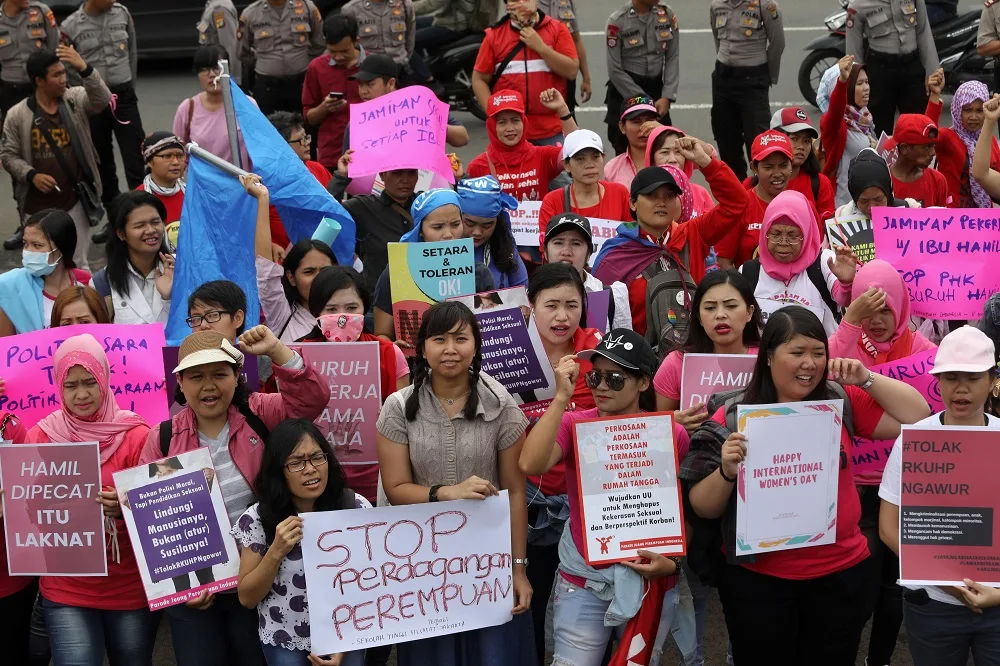

We’re always demanding for one, but why it hasn’t got any better? What has been causing all of this?
The world has never been a safe place for women. Specifically in Indonesia, patriarchy is something that most of the people normalized. Women has to stay at home and do housework. Women can’t go anywhere safely. Catcallers, pedofiles, people with fetish exist and women needs to hide from them.
Women got blamed for everything they do. People said they were sexualizing themselves for excusing predator’s behavior. Some also said it is obligated for women to become male’s servant just because some bigwig said so.
One in three women experience physical or sexual violence. Even lately, men have also became a target of sexual harrasment. According to United Nations, it may take close to 300 years to achieve full gender equality.
It all was started back in 2 million years ago. The first sexual division of labour were founded. Females are originated with the invention of cooking, while male are invented to hunt. This social norms are improving and crept into border region, including Indonesia.
In cities like ancient Athens, entire cultures had developed around misogynistic myths that women were weak, not to be trusted, and best confined to the home. So, they began to restrict women’s sexual freedom.
Exploitation of women within patriarchal marriages continues. Forced marriage, the most extreme version of this, was designated a form of modern-day slavery by the International Labour Organization in its statistics for the first time in 2017.
The most recent estimates, from 2021, indicate that 22 million people globally live in forced marriages. people continually recreate women’s inequality through their daily behaviors, perceptions, and choices. and so, patriarchy became a culture and mindset that is deeply ingrained in Indonesia. They mix regional traditions and religion with patriarchy to justify it.
Read more: Melepas Kacamata Patriarki dalam Membangun Politik Berbasis Gender
Woman’s body and life are not depending on someone else’s decision. Like every man, woman deserves to stand on their own feet. They had enough. Back then we only have R. A. Kartini, now Indonesian’s Womans are vocal their rights. They don’t remain silent anymore. Gender equality cannot be deferred until other SDGs are resolved.
Achieving gender equality requires bold and sustained commitment across governments, private sector, international organizations, and civil society. The actions outlined by UN, the World Bank, other international bodies, and Indonesian goverment provide a comprehensive roadmap, but the progress depends on how they translate and actualize these commitments.
The evidence is clear, when women have equal rights, opportunities, respect, and participation in decision-making, economies grow, societies become more stable, and progress on all SDGs accelerates. The longer we wait, the more it will cost society in lost potential, productivity, and well-being.
So, will the problem of gender equality ever end? And when? The goal, therefore, is not a finish line where all problems are solved. It is the continuous, conscious, and collective effort to bend our institutions, our cultures, and our own minds toward greater fairness and freedom for every individual, regardless of gender.
It is an ongoing revolution, not just for our generation, but for all those to come and those who exist before. The work hasn’t finished, but that does not means never or makes any of our effort less worthy. Together, let’s work for a more inclusive, just, and prosperous world for women and men, everywhere.
Author: Naurah Shadrina
Mahasiswa Teknik Industri, Universitas Brawijaya
Aktivist in AIESEC in UB
Reference
1. Saini, A. (2023, May 25). How did patriarchy actually begin? BBC Future. Diakses pada 4 November 2025, from https://www.bbc.com/future/article/20230525-how-did-patriarchy-actually-begin
2. United Nations Department of Economic and Social Affairs. (2022, September 7). Achieving full gender equality is still centuries away, warns the UN in new report. Diakses pada 6 November 2025, from https://www.un.org/en/desa/achieving-full-gender-equality-still-centuries-away-warns-un-new-report
3. Wikipedia contributors. (2025, July [month day]). Patriarchy. In Wikipedia, The Free Encyclopedia. Diakses pada 4 November 2025, dari https://en.wikipedia.org/wiki/Patriarchy
Editor: Salwa Alifah Yusrina
Bahasa: Rahmat Al Kafi
Ikuti berita terbaru Media Mahasiswa Indonesia di Google News

⚡ Baca Lebih Cepat Artikel MMI di Ponsel Anda!
Ikuti Channel WhatsApp
Media Mahasiswa Indonesia (MMI):
KLIK DI SINI