
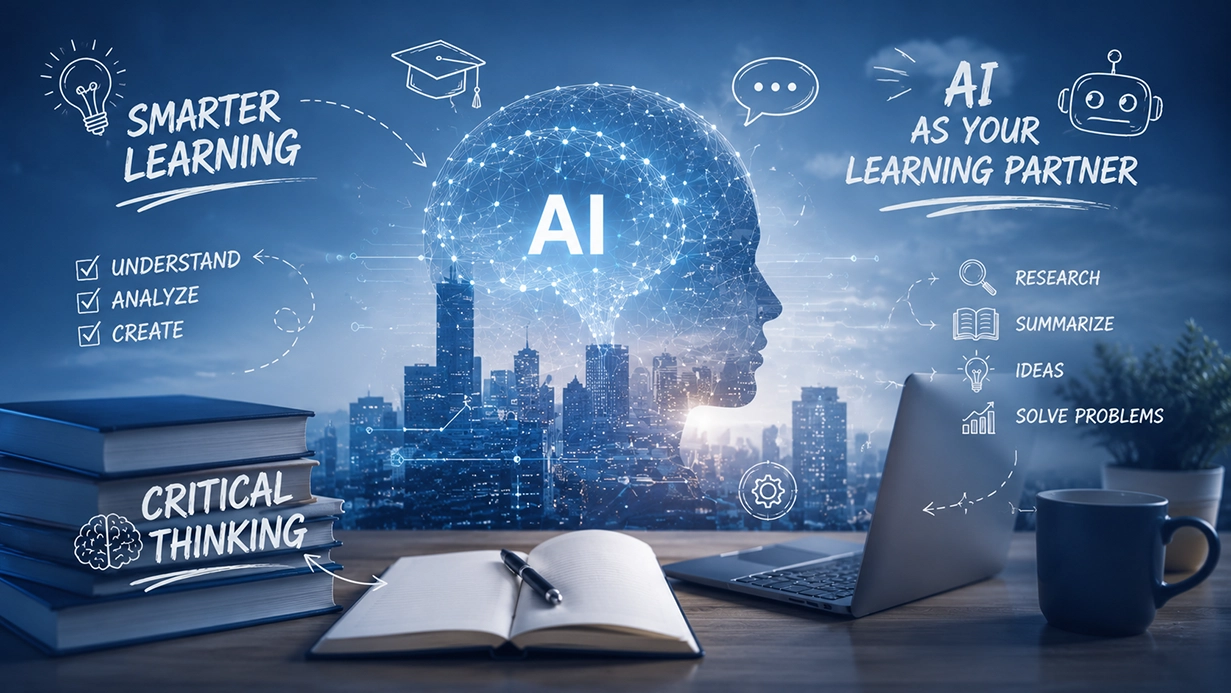

What if the smartest student in your class isn’t studying alone, but with the help of artificial intelligence? In recent years, artificial intelligence (AI) has transformed the way university students learn. With tools such as ChatGPT, Gemini, and Microsoft Copilot, students can gain instant explanations, generate ideas, and receive feedback within seconds—all they need is an internet connection. However, this growing dependence raises an important question: Is AI truly becoming a study partner, or is it turning into a shortcut that weakens students’ critical thinking skills?
AI is now widely used in many aspects of daily life, including education. Various AI-powered platforms, such as ChatGPT, Gemini, and Microsoft Copilot, are now easily accessible and widely used for different purposes. For university students, AI has become an important learning tool both inside and outside the classroom. It helps students understand course materials through more detailed explanations, especially when they need additional clarification beyond what is covered during lectures. AI is also used to generate ideas, develop creative solutions, and improve grammar and writing quality for academic assignments. When used responsibly, AI can support more effective learning by helping students study more efficiently, rather than relying solely on face-to-face lectures or textbooks.
The growing role of AI in education is also reflected in recent research. According to the Digital Education Council’s Global AI in Higher Education Survey 2026, 88% of university students and 77% of lecturers already use AI in learning and teaching. These findings show that AI is no longer an emerging technology—it has become part of everyday academic life. However, the same survey also revealed that many students receive little guidance on how to use AI responsibly. This highlights an important challenge: while AI adoption is increasing rapidly, digital literacy and ethical guidelines have not always kept pace.
However, for students who rely on AI in almost every stage of their learning process, excessive use can lead to unhealthy dependence if it is not used wisely. Some students may begin to underestimate the importance of completing assignments independently. Instead of analyzing problems or developing their own ideas, they simply ask AI to generate answers and copy them without further evaluation. While this approach may save time, it does not necessarily contribute to meaningful learning. Over time, such dependence can reduce students’ ability to think critically, solve problems independently, and develop their own understanding. For example, when assigned to summarize a chapter from an accounting textbook, a student might simply upload photos of the pages and ask AI to produce the summary. Although the assignment is completed more quickly, the opportunity to read, analyze, and truly understand the material may be lost. Therefore, if AI is used without responsibility, it can weaken the learning process rather than improve it.
The best way to respond to the rapid development of AI is to use it wisely and responsibly rather than allowing it to replace the learning process. AI can be a valuable tool for understanding how a concept works, discussing solutions to problems, finding reliable references, and generating creative ideas.
However, responsible AI use also requires students to verify the information it provides. AI does not always produce accurate answers. In some cases, it may generate incorrect data, inaccurate figures, or even fabricated references while presenting them with confidence. Therefore, students should avoid simply copying and pasting AI-generated responses without checking them against trustworthy sources.
Moreover, using AI effectively requires the ability to write clear and specific prompts. The quality of AI’s response largely depends on the instructions it receives. Learning how to communicate effectively with AI is also an important digital skill that students should develop.
The responsibility for ethical AI use should not rest solely on students. Lecturers and educational institutions also play an important role in promoting responsible AI practices. Universities can organize seminars, workshops, or discussions on the ethical use of AI so that students understand both its benefits and its limitations.
Ultimately, AI should not be used as a shortcut to complete assignments but as a study partner that supports learning while encouraging students to think critically, solve problems independently, and continue developing their own knowledge and creativity.
Artificial intelligence is one of the greatest innovations that can support the learning process, not hinder students’ ability to think independently. However, technology should strengthen students’ abilities rather than replace them. Using AI is not the problem. The real problem begins when students stop thinking and allow AI to think for them. When used wisely, AI can become an excellent study partner that enhances learning. However, it should never become a shortcut that prevents students from developing critical thinking, creativity, and independent problem-solving skills.
Penulis: Farida Dhifa Syakira
Mahasiswi Program Studi D4 Akuntansi Sektor Publik, Universitas Harkat Negeri (UHN)
Editor: Darsono. AR
Bahasa: Rahmat Al Kafi
⚡ Baca Lebih Cepat Artikel MMI di Ponsel Anda!
Ikuti Channel WhatsApp
Media Mahasiswa Indonesia (MMI):
KLIK DI SINI