
Globalization and technological developments have made information and knowledge easier for people to access. This condition also makes English skills increasingly important, especially for young people, because English is widely used in education, communication, and various opportunities in the future.
Nowadays, English is not only learned as a foreign language, but it has also become an important skill needed in communication, both spoken and written. Mastering English can help young people develop in various aspects of life, such as expanding career opportunities, supporting opportunities to continue education abroad, and making it easier to access various sources of information.
However, on the other hand, Indonesian young people also have a responsibility to preserve local languages, such as the Acehnese language, because they are an important part of culture and are still used within families and communities.
Indonesia is a large country, decorated with diversity in multiple forms, including the amount of local language spoken within and Indonesian as the national language. This language diversity strongly affects how students think and learn English (Nursati, 2021; Liando et al., 2022).
Using local languages in daily life can be one of the ways to preserve local culture so that it does not gradually disappear amid rapid global developments.
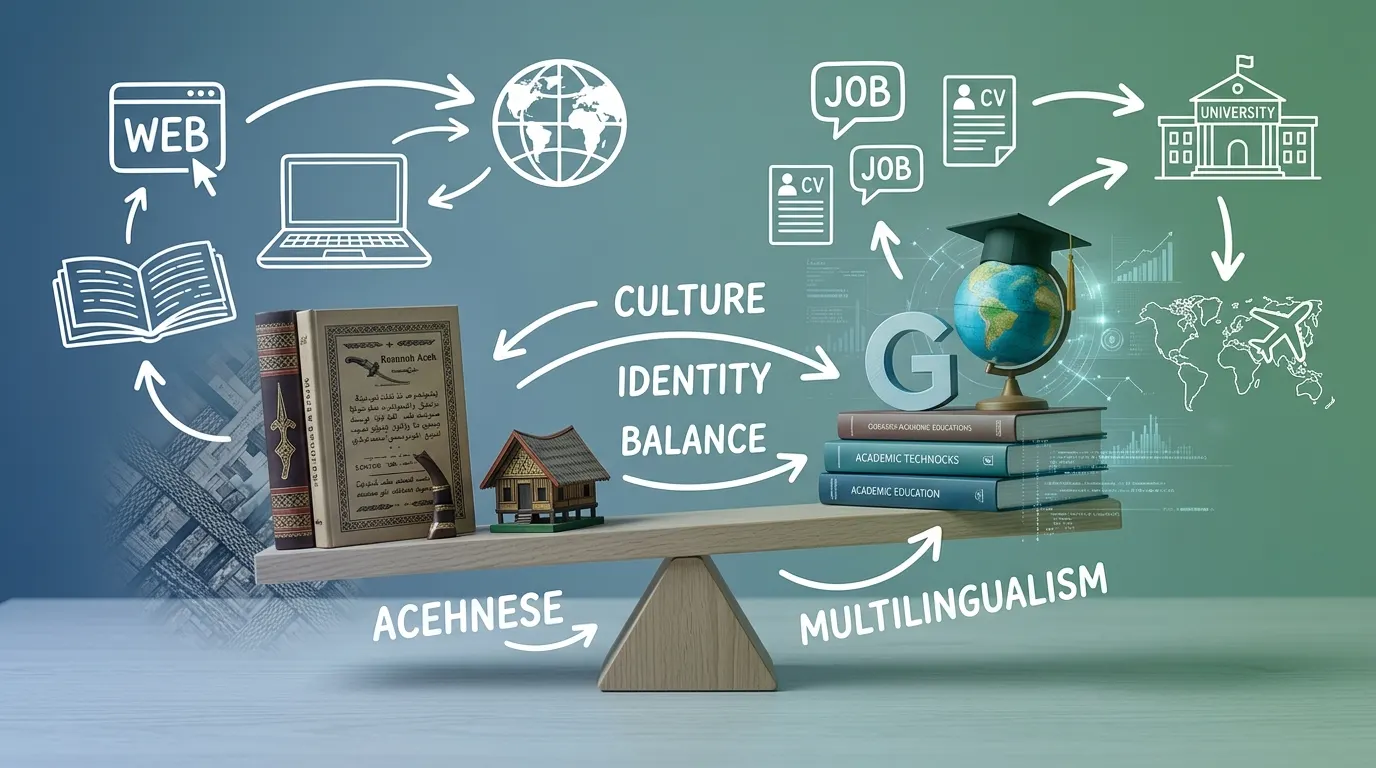
Therefore, the younger generation has an important role in maintaining a balance between preserving local languages and strengthening English because both can provide benefits in expanding social relationships and academic achievement, as well as helping reduce communication gaps between generations caused by the declining use of local languages.
Read more: Kemandirian Prabowo VS Solidaritas Global: Pelajaran dari Bantuan Asing Bencana Sumatra 2025
To start, balancing the proficiency between a student’s local and foreign language offers many benefits, one of them being the significant social impact.
By preserving their local language, students are able to bring themselves better to the community around them, blending within the cultural circles easily and adapt well, as language proficiency breaks any possible language barrier that can cause misunderstandings between citizens, creating trust and harmony in the relationship between students and their local society.
Meanwhile, strengthening students’ proficiency in English, as a widely-spoken foreign language, gives them the opportunity to spread their global networking abilities, which is very important given this era of globalisation.
English allows students to communicate beyond their local environment, as they are able to connect with international peers, as well as conferences, abroad scholarships and careers, since many of these programs or community resources use English.
That being said, balancing both languages helps students create a wider social approach, because while Aceh, as a local language, guides students into familiarity with their native surroundings, English as a foreign but universally used language can help them in a wider society that reaches international linkages.
Aside from benefiting students in their social connections, combining bilingual learning habits can facilitate students’ academic achievement by improving their ability to comprehend complex instructions through enhanced cognitive flexibility.
As noted by Acharya (2024), “Beyond the acquisition of multiple languages, bilingualism has been shown to confer a range of cognitive benefits that significantly impact problem-solving, memory retention, multitasking abilities, and executive functions.”
These cognitive advantages can strongly support students’ academic achievement. Bilingual habits should be developed over time through the integration of day-to-day practice in using both local and foreign languages, which will improve language usage effectively.
The cognitive and communicative abilities of EFL learners in classrooms may exceed those of learners who master only one language. Nurturing the Acehnese language helps students in Aceh grasp meaning in communication locally while also fostering cognitive and linguistic development in English, which supports the students’ academic growth in the globalization era.
This impacts students’ learning experiences as well as their ability to acquire and adapt to new knowledge. However, maintaining the local Acehnese language has become progressively challenging on account of its declining use among younger generations in this globalized world, causing an imbalance in the proficiency of both languages.
The imbalance in question refers to the dominance of English among EFL students that has led to a decline in the use of Acehnese, creating a gap between the younger and older generations. According to Murtisari and Mali (2017), the increasing dominance of English may affect the maintenance of Indonesian language and culture among young people. Many students use English more frequently in their daily lives and on social media.
Consequently, the Indonesian and Acehnese language is used less and less at home, making it difficult for older people such as grandparents who are fluent in Acehnese to communicate with their grandchildren. A communication gap has emerged between younger and older generations, which can hinder the preservation of the Acehnese language and the Indonesian language as national identity.
With such barriers in place, the decline of the Acehnese language may also cause younger generations to lose their sense of pride in their local language, leading to even more frequent use of English. This may gradually have dire consequences because it leads to the loss of the sense of nationalism that has been passed down from generation to generation.
Therefore, to maintain a balance in the use of Indonesian, Acehnese and English, the younger generation can commit to using Indonesian and Acehnese at home and using English in school and on social media. With awareness, the younger generation can maintain a balance in the use of the local language and foreign languages without losing their local identity.
In conclusion, keeping the balance between the use of Indonesian as the national language, Acehnese as the local language and English as a foreign language is very important for EFL students in the era of globalization. English has many benefits in education, international communication, and career prospects.
On the other hand, Acehnese is just as important as a cultural identity and local heritage that must be preserved by generations. With three of them, students can enhance their ability on social interaction, academic and daily communication.
On the far side, the overuse of the English language can be one of the factors of the declining use of Indonesian and Acehnese amongst the youths. This can trigger social discrepancy between generations and threaten the preservation of local culture.
According to Mouboua et al. (2024), implementing comprehensive strategies that emphasize multilingual education can help overcome these challenges.
Therefore, in order to mitigate the imbalances stated, educational experts advocate for structured multilingualism, meaning that both languages can be balanced by using them accordingly, such as local language usage at home around relatives in the local community, using the Indonesian language in formal settings or with friends around the country, and English in global networking matters.
By maintaining the balance, our young generation can become an individual that will be able to compete worldwide without losing their identity as Indonesian and Acehnese citizens.
Penulis:
- Alifah Putri Fadliawati
- Hadiva Zahra
- Ratu Nabila Adehaija
- Syamim Az-zahra Iskandar
- Wina Dara
Mahasiswa Pendidikan Bahasa Inggris, Universitas Syiah Kuala
Dosen Pengampu: Yuliana Anggraini Syarifuddin S.Pd M.AppLing
Editor: Salwa Alifah Yusrina
Bahasa: Rahmat Al Kafi

⚡ Baca Lebih Cepat Artikel MMI di Ponsel Anda!
Ikuti Channel WhatsApp
Media Mahasiswa Indonesia (MMI):
KLIK DI SINI