
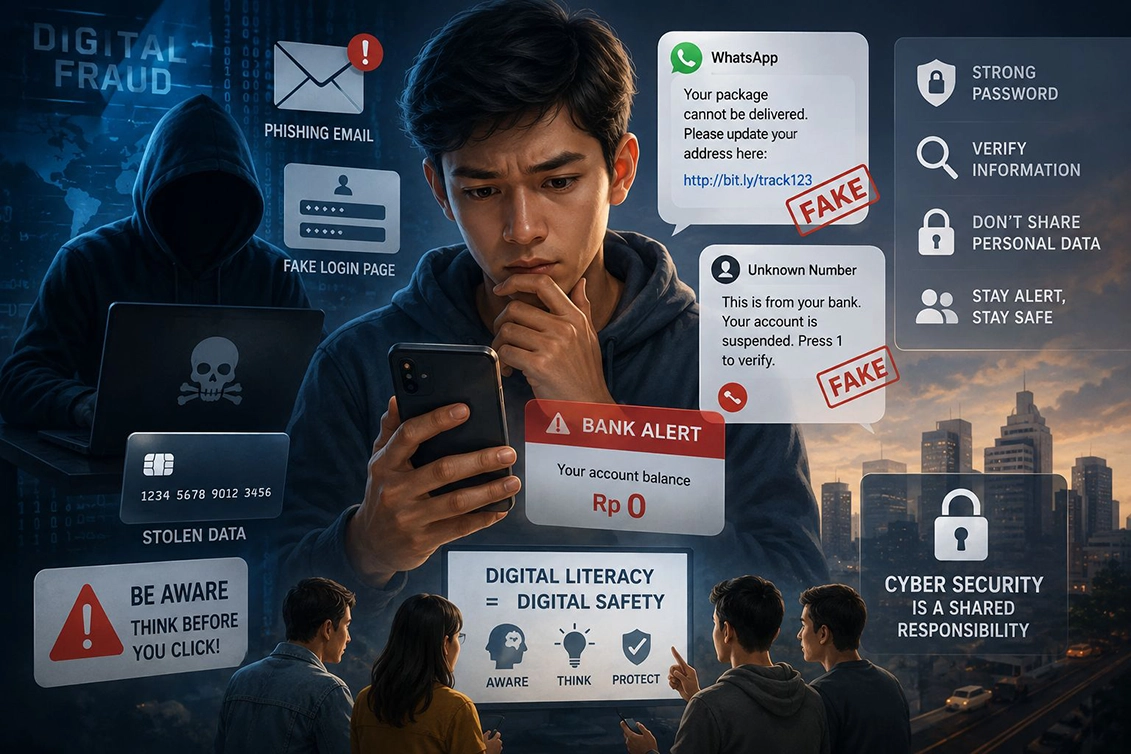

Ever imagined waking up and finding out your bank account is empty or your personal data is leaked everywhere, just because you accidentally clicked a fake tracking link on WhatsApp? Scary, right?
The truth is, this is no longer just a story from a hacker movie because digital fraud has become a real problem that happens every day to many people. As technology continues to grow rapidly, scammers are also becoming more creative in finding ways to trick users.
Their tactics are getting more advanced and difficult to recognize, which makes people more vulnerable to cybercrime. This situation shows that behind the convenience of digital technology, there are still many security gaps that can put users at risk if they are not careful.
The Human Factor and Social Engineering
In my opinion, solving the problem of digital fraud cannot rely only on applications, banks, or technology companies. Although security systems continue to improve, scammers are now targeting human psychology through social engineering.
They manipulate emotions such as panic, fear, curiosity, or excitement to make victims act carelessly. For example, fake courier messages or calls pretending to be bank officers often make people panic and share personal information without thinking twice.
This proves that no matter how advanced technology becomes, users can still become victims if they do not have enough digital awareness and critical thinking skills.
The Need for Global Collaboration and Regulation
Furthermore, digital fraud has become even more complicated because cybercriminals can operate from anywhere, including across countries. This makes it difficult for law enforcement to track and stop them.
Therefore, governments and technology companies must work together to create stronger regulations and better security systems to protect users’ personal data. International cooperation is also necessary so cybercriminals can be identified and punished effectively.
Without strong collaboration between users, governments, and technology companies, people will continue to become easy targets for online scams.
Balancing Platform Responsibility and User Awareness
Some people argue that online security should be entirely the responsibility of banks and digital platforms because they earn huge profits and should provide perfect security systems. While this opinion is understandable, it is important to realize that scammers will always try to find new ways to attack users directly.
Technology alone cannot fully protect people if users themselves are careless or unaware of online dangers. Relying only on security systems without improving digital literacy is like having a strong lock but giving the key to strangers. User awareness remains one of the most important defenses against cybercrime.
Conclusion: A Shared Responsibility for a Safer Digital Environment
In conclusion, the rise of digital fraud should serve as a major wake-up call for everyone. Staying safe online is not only about changing passwords regularly, but also about being careful, critical, and responsible when using digital platforms.
People should avoid trusting information too quickly, especially offers or messages that seem too good to be true. Being more skeptical and aware online can help prevent serious problems in the future.
Cybersecurity is not only the responsibility of governments or companies, but also the responsibility of every internet user. One careless action can create consequences not only for ourselves but also for others.
Therefore, improving digital awareness and practicing safer online behavior are essential steps in reducing digital fraud and creating a safer digital environment for everyone.
Penulis: Zafira Purnama Harani (25110031)
Mahasiswa Program Studi Akuntansi Sektor Publik, Universitas Harkat Negeri
Dosen Pengampu: Muchammad Sofyan Firmansyah
Bahasa: Rahmat Al Kafi

⚡ Baca Lebih Cepat Artikel MMI di Ponsel Anda!
Ikuti Channel WhatsApp
Media Mahasiswa Indonesia (MMI):
KLIK DI SINI