
Abstract
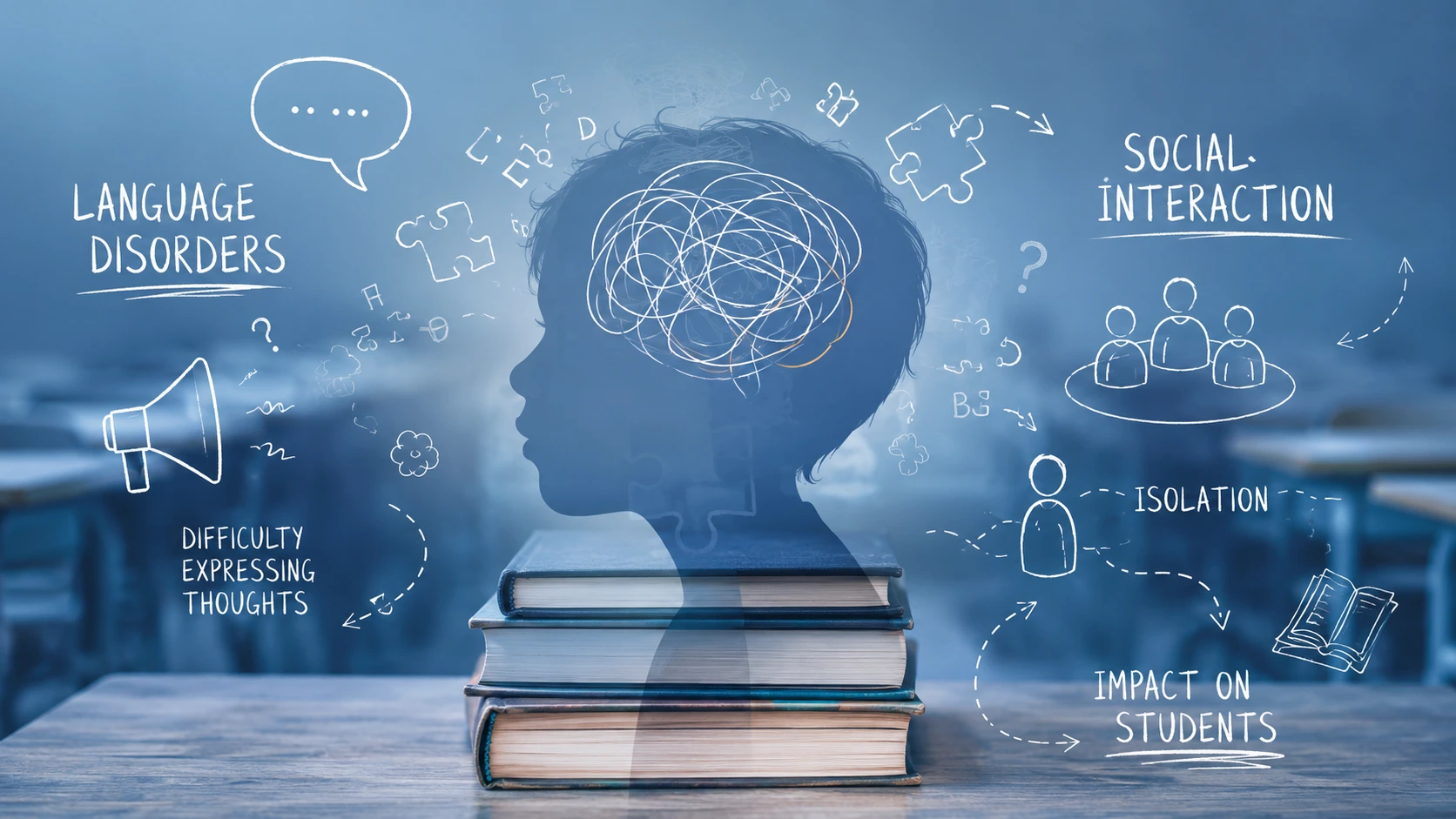
Students’ ability to interact socially in the learning environment, as well as their communication skills, can be affected by language disorders. Those with language difficulties often struggle in expressing their thoughts, understanding conversations, and taking part in classroom discussions. Such challenges may result in withdrawal, decreased self-esteem, and obstacles in forming friendships with peers. Exploring how language disorders affect students’ social interactions in educational institutions is the aim of this study. Using a qualitative methodology, this study gathered insight through interviews, observations, and document reviews to gain a deeper understanding of the students’ experiences. The results indicate that language disorders had a significant impact on communication, friendships, emotional expression, and involvement in class activities. However, this study also revealed that students with language disorders have a strong desire to form social connections and a willingness to be accepted by their peers. The support provided by educators, fellow students, and inclusive educational settings is crucial in assisting these students to enhance their social engagement and involvement in school functions. Thus, creating supportive and welcoming educational environments is crucial for fostering better communication and social engagement among students.
Keywords: language disorders; social engagement; communication struggles; inclusive learning; students
Instruction
Language plays an important role in human communication, especially in educational settings by exchanging knowledge and enhancing learning effectiveness in fostering teacher-student and student-student communication (Ansari, 2022). In classrooms, language is used not only to convey academic material but also to express ideas, share opinions, and make use of various linguistic resources, build supportive relationships, and participate in social activities. Effective communication such as positive language, constructive feedback, and supportive learning environment can help students understand the subject matter, become more engaged and achieve better academic results. Shivani and Tamilselvi (2024) states that communication through language is essential for creating meaningful interaction in educational contexts. Therefore, students’ language ability are closely link to their academic achievement and social participation at schools.
However, not all students acquire language skills in the same way. Some students have language disorders that affect their ability to both understand and generate language effectively. Gillham (2022) explains that language disorders refer to difficulties in the understanding and using spoken, written, or other symbol systems, These difficulties may include issues related to language structure, content, and language use, which can hinder communication and social interaction. Language disorders can take many forms and levels of severity. Some students may have expressive language disorders, which may affect their ability to communicate ideas verbally, while others may have difficulties understanding information from others. In some cases, students may experience both expressive and receptive difficulties understanding information from others. In some cases, students may experience both expressive and receptive difficulties at the same time. This can lead to misunderstanding during communication and cause frustration or anxiety in social situations. Therefore, additional support in educational settings is often needed so that students with language disorders can communicate more effectively and actively participate in classroom interactions.
Children and teenagers with language disorders have been shown to experience multiple social difficulties in previous studies. Students with developmental language disorders often face peer-social skill impairment, including conversations maintenance, comprehension of social signs and appropriately solving interpersonal conflict. According to Law et al (2017), children with language difficulties are at higher risk for social isolation and tend to have fewer positive peer relationships compared to their peers without language difficulties. Similarly, Norbury et al. (2016) highlighted that limitations of these skills may also reduce students’ discussions. These findings indicate that language disorders are both linguistic learning problems, and also social problems in the classroom. Students with language impairment may be more likely to feel lonely or isolated from peers or suffer difficulties in making friends which can affect their peer relationships and participation within school communities.
In educational settings, social interaction is one of the crucial themes of students’ development. In the process, they learn cooperation, problem solving, emotion control, and other social skills by interacting with teachers and classmates. In a school, practicing positive social interaction can boost the confidence, motivation, and sense of belonging for students. However, students’ participation in social and academic activities can be complicated and hindered by communication challenges. Students with language disorders may want to participate in conversations or group work but are unable to communicate effectively. As a result, they may become more passive, withdrawn, or unsure to contribute to classroom discussions.
Students with language disorders were struggling mentally as well to cope with their difficulty in communication also has been found by the researcher. When students are unable to express themselves clearly or understand others when communicating, they often feel some negative emotions, such as feeling embarrassed, anxious, or low in self-confidence. These combined emotions can lead to a reduced interest in social interactions and negatively impact their bonds with peers. Sometimes, classmates may perceive students with language disorders as shy, unfriendly, or lacking in ability, when in fact these students simply have difficulty in communicating.
Supporting students with language disorders is also a crucial role that teachers and the entire community of schools must have and play. One of the roles that can be achieved is by implementing inclusive teaching. Inclusive teaching allows students to feel accepted and empowered to participate in classroom activities. Engaging, friendly teachers who offer step-by-step explanations and interactive experiences with plenty of constructive feedback may help students grow not just in their communication skills, but also in social self-assurance. In addition, classmates who demonstrate understanding and empathy can contribute to creating positive peer relationships for students with language difficulties, The concept behind inclusive education state that if the ability to communicate is what separates students in grades, then school should provide all students with both equal opportunity and availability of materials to participate actively in learning and social interaction.
However, while there have been numerous studies involving language disorders and communication challenges, research has directly looked at how these factors relate to students in educational or social interaction. Most previous studies focused on either academic or clinical domains related to language disorders, yet less frequently examines students’ daily interaction, friendship development, emotional expressions, and classroom participation.
Based on these issues, this study seeks to investigate the effect of language disorders on students’ social performance in educational contexts. This study examines the influence of problems with language on students’ peer interaction, engagement in school context and social-emotional experience. The findings of this study are expected to provide deeper understanding for educators, researchers, and schools about the importance of supporting students with language disorders. The study may further lead to development of more inclusive learning environments that promote positive social interaction while allowing equal participation for all students.
Research Questions
- In what ways do language disorders impact students’ ability to communicate in educational environments?
- What effect do language disorders have on students’ interactions with peers and their engagement in classroom activities?
- What social and emotional difficulties do individuals with language disorders encounter?
- How do language disorders influence relationships among peers and the overall senses of belonging for students within school settings?
Methods
To investigate how language disorders affect students’ social interaction in an educational context, this study employed a qualitative method. This method was chosen as it allows for a detailed examination
of the experiences, views, and actions of participants. Creswell (2014) notes that qualitative studies are suited for comprehending social phenomena from the viewpoints and experiences of those involved. This method was considered appropriate because the research concentrated on how students with language impairments navigate communication and interactions in school environments.
Respondents
This study involved students with language disorders, educators, and parents as participants. The researcher selected them using a purposive sampling, as their insights were considered significant to the research topic. The participants were students from elementary and secondary schools who had experienced communication challenges during classroom activities. Educators were involved in this study because they have direct observations of student engagement, communicative abilities, and student interactions with classmates during the learning process. The researcher also consulted with parents to gain additional insights into student’s communicative actions and socializations outside of the school context. To ensure confidentiality and protect the privacy of participants, anonymized names were used instead of actual names throughout the research.
Instruments
The main instrument in this research is the researcher themself. In qualitative research, the researcher plays a key role in the collection, understanding and analysis of data. Complementary tools include interview guides, observation checklists and field notes. These interview guides were developed on the basis of the research objectives and previous studies on language disorders and social interaction. These questions focus on communicative experience, friendship, participation in class and emotional responses during social interactions. An observation checklist was used to record the pupils’ communicative behavior, their participation in class discussions and their interactions with the teacher and their classmates. In addition, field notes were used to record the relevant situations and behaviours observed during the research process.
Data Collection Procedures
The data was collected through a combination of semi-structured interviews, classroom observations and document analysis. The semi-structured interviews were designed to provide an in-depth to the participants’ experiences and perceptions. Kvale (2007) notes that semi-structured interviews give participants the opportunity to share their thoughts and experiences more openly, without straying from the research and objectives.
Discussion with pupils focused on their experiences of interacting with teachers and classmates, their participation in classroom activities, and their ability to make friends with the school environment. Discussions with teachers focused on how pupils participated in class, the difficulties they encountered in communicating, and the teaching methods used to support pupils with language disorders. Meanwhile, discussion with parents centred on how pupils communicated and interacted socially outside the classroom.
Classroom observations were carried out to analyse pupils’ interactions in a real educational context. During these observations, the researchers paid particular attention to how pupils participated in discussions, their contributions during group activities, and their interaction with their peers and teachers. This observational approach enabled the researchers to identify behaviors and patterns of interaction that might not have been adequately revealed in the interviews.
In addition, document analysis was used to corroborate the findings obtained from the interview and observations. The documents ana;ysed included teachers’ notes, pupils’ academic records and reports on the development of pupils’ communication skills. By using a variety of data collection methods, the researchers were able to obtain richer and more detailed information.
Data Analysis
The information gathered was analysed using thematic analysis. This technique was used to identify trends, themes and meanings based on the insights obtained through interviews, observations and a review of the literature. Braun and Clarke (2006) describe thematic analysis as a flexible approach to examining qualitative data and identifying recurring themes found in participants’ experiences.
The analysis begins with the transcription of the interview recordings, followed by repeated reading of the data to enhance understanding of its content. The researchers then identify key statements and systematically code the relevant data. Codes with similarities are subsequently grouped into broader categories and themes relating to communication challenges, peer relationships, emotional experiences, classroom participation and social support.
In conclusion, the researchers, the teachers analysed these issues to understand how language disorders affect pupils’ social interaction in the educational setting. To ensure the reliability of the research findings, data triangulation was carried out by comparing the results of the interviews, observations and document analysis. This approach helped to enhance the validity and reliability of the research conclusions.
Findings and Discussion
The findings indicate that language disorders have a significant impact on student’s social interactions in educational settings. Based on the interview, classroom observations, and document analysis, several themes developed related to communication difficulties, avoiding social interaction, emotional challenges, peer relationship, and student’s social motivation. The data shows that language disorders affect not only student’s communication abilities but also their participation and relationship in school environments.
Finding 1: Communication Difficulties in Social Interaction
The study found that students with language disorders often experience difficulties in communication, especially when they have to express their ideas, understand conversations, and respond appropriately in social interactions. During classroom observations, there were some students who were hesitant to participate in discussions because they struggled to find the right words or express their thoughts clearly. Some students also need more time to respond to teacher’s questions and often rely on short or incomplete answers.
Teachers reported that communication difficulties often caused misunderstandings between students and their peers. In some cases, their classmates misunderstood students with language disorders because they could not communicate their intentions effectively. These communication barriers sometimes can lower a student’s self-confidence and readiness to participate in classroom conversations.
This findings supports Gillham’s (2022) explanation that language disorders are related with comprehension and production of language, which may significantly affect communication. The results are also consistent with previous studies done by Law et al. (2017), which showed that children with language difficulties often experience challenges in their social communication and interactions with others. These findings indicate that communication competence is an important factor in supporting positive social interactions in school environments.
Finding 2: Social Withdrawal and Isolation
Another important finding is that many students with language disorders often feel socially isolated and avoid interaction with others. Some participants reported that they often stay away from others because they feel anxious, embarrassed, or worried about being misunderstood by other people. Classroom observations also showed that some students preferred to stay quiet during group activities and talk less with classmates.
Teachers have noticed that students with language disorders were often less active in collaborative learning activities compared to other students. When participating in conversations, some students appear uncomfortable and often isolate themselves from their peer group. These behaviors indicate that communication difficulties can lower students’ confidence in social situations.
This finding is supported by previous research showing that children with language disorders are more likely to experience social isolation and favor positive peer relationship also pointed out that limitation in pragmatic language skills may affect students ability to participate effectively in social communication the findings of the study suggest that communication problems may lead to emotional and security and social with travel in student with language disorder.
Finding 3: Difficulties in Emotional Expression and Conflict Management
The findings also show that students with language disorders often have problems in resolving conflicts and showing their emotions. Some students found it hard in explaining feelings like sadness, anger, or frustration during social interactions. Because of this, there were often misunderstandings between students and those around them.
Teachers reported that many students felt frustrated when they could not express themselves clearly the way they wanted during disagreements or classroom discussions. Since they could not share what they really wanted, students sometimes prefer to stay quiet, avoiding interaction, or feel overwhelmed.
Another finding revealed by this study is that language abilities are closely related to emotional regulation and interpersonal communication. Students who experienced language difficulties may struggle to solve conflicts in an appropriate way because of their limitation in explaining their thoughts clearly. These findings match the idea that language development affects children’s feelings and social skills. So, communication support is very important not only for academic purposes but also for their emotional and social growth.
Fining 4: Peer Relationship and Sense of Belonging
The study also found that language disorders affect student’s relationships and sense of belonging in the classroom. Several students explain that they want to build their friendships and participate in social activities but sometimes it is too difficult to join a conversation to group interaction. Some participants reported feeling excluded because they could not communicate as easily as their classmates.
Teachers observed that students with language disorder often have smaller friendship circles and interact with fewer peers compared to other students who do not have communication difficulties. Sometimes it is difficult for them to maintain conversation and develop close relationships. Because of that, some students experience feelings of loneliness and are reduced participation in classroom communities.
These findings support previous studies which indicate that language difficulties may influence friendship development and peer acceptance. Positive interaction is important because it contributes to students’ emotional well-being, confidence, and classroom engagement. When students experience barriers in communication they may also experience difficulties in developing social identity and belonging in educational settings.
Discussion
The social interactions of students in the classroom environment are greatly affected by linguistic disorders as shown in the results of this study. Their involvement in classroom activities, relationships with classmates, emotional expressions, and participation in classroom activities, relationships with classmates, emotional expressions, and participation in conversations are a number of aspects of children’s school experiences caused by communication problems. These difficulties frequently lead to emotional distress, social isolation, and limited participation in social settings.
The findings align with earlier research by Law et al. (2017) and Norbury et al. (2016), which highlighted how language impairments impact social development and peer interaction in addition to communication abilities. This study also emphasizes how communication difficulties might affect students’ self-esteem and emotional health in learning environments.
The results also showed that students with language difficulties maintained their social motivation despite these barriers. The desire to be accepted by peers, to build friendships, and to participate in group activities was frequently expressed by children with language disorders. This suggests that students’ enthusiasm in social contact is not diminished by communication challenges, and that students often need a supportive environment that encourages engagement and understanding.
Students’ social interaction has been shown to improve significantly thorugh inclusive classroom methods and teacher support. Students participated more actively in class activities when teachers offered clear directions, encouraging feedback, and organized chances for involvement. Students’ self-assurance and emotional comfort during communication were similarly influenced by positive peer interactions.
According to these results, schools should establish more inclusive classrooms that help students with language difficulties succeed academically and socially. Giving kids emotional support, cooperative learning opportunities, and communication assistance may strengthen their social skills and increase their involvement in classroom activities. Teachers should therefore be aware that language impairments affect many facets of kids’ experiences and necessitate all-encompassing help within school communities.
Conclussion
In conclusion, this study demonstrates that language disorders have a significant impact on pupils’ social interaction within the educational setting. Pupils’ ability to take part in conversations, express emotions, build relationships with their classmates and participate actively in classroom activities is affected by communication difficulties, as the results of this study show. As a result of this situation, many pupils often experience misunderstandings, social isolation, self-esteem and difficulties in forming social relationships within the school environment. These various challenges can affect not only pupils’ social development, but also their academic engagement and emotional wellbeing.
However, according to the findings of this study, pupils with language disorders continue to demonstrate strong social motivation and a desire to be accepted by their peers. Despite the communication difficulties they face, many of them continue to value friendship and social interaction. These findings highlight that an inclusive and supportive educational environment plays a key role in helping pupils improve their self-esteem and communication skills.
Therefore, teachers, parents and the school must provide appropriate support to pupils with language disorders through effective collaboration. More active participation in social and academic activities can be encouraged through inclusive classroom activities, opportunities to interact positively with peers, and communication strategies that support them. Furthermore, it is necessary to examine the wider educational context and conduct further research, through additional studies, into more effective strategies for supporting pupils with language disorders in a variety of learning environments.
Writer:
1. Arifa Lutfiya A. P (2302040126)
2. Najwa Dhabita Naftaly (2302040148)
3. Keysha Salsabilla N (2302040150)
4. Sekar Wulandhari (2302040174)
5. Kushardiyanti Novinda, S.Pd., M.Pd.
English Education student at Universitas Negeri Semarang (UNNES).
References
Aguilar-Mediavilla, E., O’Kearney, R., Adrover-Roig, D., Simon-Cereijido, G., & Buil-Legaz, L. (2022). Socio-Emotional and Educational Variables in Developmental Language Disorder (DLD). Frontiers in Psychology, 13, 882397.
Ansari, M. T. A. (2022). A STUDY OF LINGUISTICS AND COMMUNICATIVE SKILLS FOR CREATING HEALTHY TEACHER-TAUGHT RELATIONSHIPS IN THE CLASSROOM TEACHING AND LEARNING PROCESS. SHODHKOSH: JOURNAL OF VISUAL AND PERFORMING ARTS Учредители: Granthaalayah Publications and Printers, 3(1).
Cullen, H., Billingham, S., & St Clair, M. C. (2024). How do children with language disorder perceive their peer interactions? Autism & Developmental Language Impairments.
Lloyd-Esenkaya, V., Forrest, C. L., Jordan, A., Russell, A. J., & St Clair, M. C. (2021). What is the nature of peer interactions in children with language disorders? Autism & Developmental Language Impairments.
Shivani, V., & Tamilselvi, A. (2024). Unravelling the Cognitive Tapestry: An Exploration of the Interplay between Language and Thought. Shanlax International Journal of Arts, Science and Humanities, 12(S2), 89-94.
Bakopoulou, I., & Dockrell, J. E. (2016). The role of social cognition and prosocial behaviour in relation to the socio-emotional functioning of primary aged children with specific language impairment. Research in Developmental Disabilities, 49–50, 354–370.
Bishop, D. V. M., Snowling, M. J., Thompson, P. A., & Greenhalgh, T. (2016). CATALISE: A multinational and multidisciplinary Delphi consensus study. Identifying language impairments in children. PLoS ONE, 11(12), e0158753.
Blaskova, L., & Gibson, J. L. (2021). Reviewing the link between language abilities and peer relations in children with developmental language disorder: The importance of children’s own perspectives. Autism & Developmental Language Impairments, 6, 1–18.
Blaskova, L., & Gibson, J. L. (2024). Exploring concepts of friendship formation in children with language disorder using a qualitative framework analysis. International Journal of Language & Communication Disorders, 59(4), 1578–1598.
Gillham, B. (2022). Language disorders and communication difficulties in educational settings. Routledge.
Law, J., Charlton, J., Dockrell, J., Gascoigne, M., McKean, C., & Theakston, A. (2017). Early language development: Needs, provision, and intervention for preschool children from socio-economically disadvantaged backgrounds. Education Endowment Foundation.
Lloyd-Esenkaya, V., Russell, A. J., & St Clair, M. C. (2020). What are the peer interaction strengths and difficulties in children with developmental language disorder? A systematic review. International Journal of Environmental Research and Public Health, 17(9), 3140.
Norbury, C. F., Gooch, D., Wray, C., Baird, G., Charman, T., Simonoff, E., & Pickles, A. (2016). The impact of nonverbal ability on prevalence and clinical presentation of language disorder: Evidence from a population study. Journal of Child Psychology and Psychiatry, 57(11), 1247–1257.
Arts, E., Orobio de Castro, B., Luteijn, E., Elsendoorn, B., & Vissers, C. T. W. M. (2022). Improving social emotional functioning in adolescents with developmental language disorders: A mini review and recommendations. Frontiers in Psychiatry, 13, 966008.
Durgungoz, F. C., & St Clair, M. C. (2025). An interactive technology-based emotion recognition intervention for children with developmental language disorder: A longitudinal mixed-method study. European Journal of Special Needs Education, 40(4), 622–638.
Hughes, L., Newton, C., Corrin, J., & Best, W. (2025). Better conversations with developmental language disorder: Feasibility and findings from an initial evaluation of a novel intervention. American Journal of Speech-Language Pathology.
Luyt, L., & Hilton, A. L. (2026). Classroom support strategies for English as an additional language or dialect students with developmental language disorder: A scoping review. Child Language Teaching and Therapy.
Medina Andrade, J. M., Miranda, C., Solís Pinilla, J. E., & Stark Gutiérrez, V. (2023). Educational interactions between teachers and elementary school students with developmental language disorders: A systematic review. Journal of Namibian Studies, 33(S3), 202–234.
Pratama, R., & Hidayati, N. (2021). Inclusive classroom communication for students with language disorders. Journal of Educational Research and Evaluation, 5(3), 210–219.
Sari, D., & Wulandari, A. (2022). Social interaction challenges among students with communication disorders in inclusive schools. Indonesian Journal of Special Education, 8(2), 115–126.
Yusuf, M., & Kurniawati, L. (2020). Teacher strategies in supporting students with language disorders in classroom interaction. Journal of Special Needs Education, 6(1), 45–53.
Dockrell, J. E., & Lindsay, G. (2017). The ways in which speech and language difficulties impact on children’s access to the curriculum. Child Language Teaching and Therapy, 33(3), 289–301.
McGregor, K. K. (2020). How we fail children with developmental language disorder. Language, Speech, and Hearing Services in Schools, 51(4), 981–992.

⚡ Baca Lebih Cepat Artikel MMI di Ponsel Anda!
Ikuti Channel WhatsApp
Media Mahasiswa Indonesia (MMI):
KLIK DI SINI