
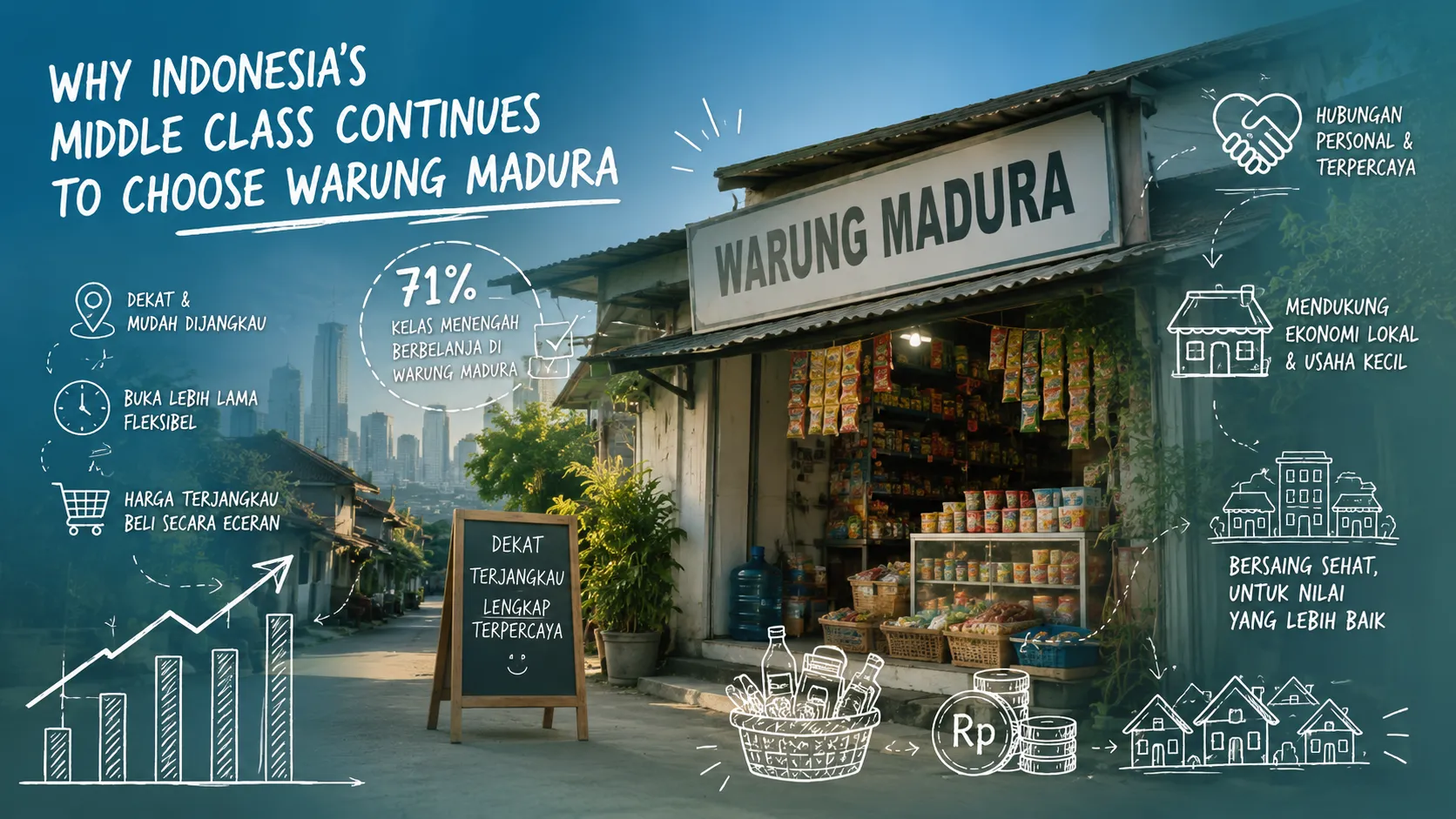

The rapid growth of Warung Madura across Indonesia has become one of the most noticeable developments in the country’s retail landscape. Once primarily associated with migrant entrepreneurs from Madura, these neighborhood stores can now be found in both urban and rural areas.
Their increasing presence is particularly interesting because it has occurred alongside the expansion of modern minimarkets and the growing popularity of online shopping platforms. This phenomenon raises an important question: Why do many Indonesians continue to choose Warung Madura despite having access to more modern retail options?
The answer may lie in changing consumer priorities. While modern retail stores offer standardized services and attractive shopping environments, many consumers still prioritize convenience, affordability, and accessibility. A 2024 survey conducted by Inventure found that 71 percent of middle-class respondents had shopped at Warung Madura.
The survey also revealed that proximity, affordable prices, and the availability of products in smaller quantities were among the main reasons consumers preferred these stores. These findings suggest that practical considerations often influence purchasing decisions more than modern shopping experiences.
One of the greatest strengths of Warung Madura is accessibility. Unlike larger retail stores that may require customers to travel farther or follow fixed operating hours, many Warung Madura are located within residential neighborhoods and operate for extended hours.
Some remain open late at night, providing an important service for customers who need daily necessities outside regular business hours. This flexibility allows consumers to purchase essential items quickly and conveniently without significant time or transportation costs.
The popularity of Warung Madura also demonstrates the resilience of micro and small enterprises in Indonesia. In an increasingly competitive retail environment, many small businesses struggle to compete with larger companies that possess greater financial resources.
However, Warung Madura has shown that small enterprises can remain competitive by understanding local consumer needs and offering services that larger retailers may not provide. Their success challenges the assumption that traditional neighborhood stores will eventually disappear as modern retail expands.
Beyond serving consumers, Warung Madura contributes to local economic activity. Many of these businesses are family-operated, providing income and employment opportunities for household members.
Their operations also support suppliers, distributors, and small-scale producers who depend on neighborhood retail networks. As a result, the economic benefits generated by these stores often extend beyond individual business owners and contribute to the broader local economy.
Another factor that distinguishes Warung Madura from larger retail chains is its social dimension. In many communities, customers develop personal relationships with shop owners through frequent interactions.
These relationships help create trust and familiarity, making the shopping experience more personal and comfortable. While modern retail stores focus on efficiency and standardization, Warung Madura often functions as a community space where social connections can be maintained through everyday interactions.
Nevertheless, the rapid expansion of Warung Madura has also generated concerns regarding competition among small retailers. Some observers argue that the growing number of these stores may reduce market opportunities for other neighborhood businesses. Although this concern deserves attention, competition is not necessarily harmful.
Healthy competition can encourage business owners to improve service quality, maintain fair prices, and adapt to changing consumer demands. Ultimately, consumers benefit when businesses compete by offering greater value and better services.
The rise of Warung Madura reflects more than the success of a particular business model. It reveals important insights into the preferences and behaviors of Indonesian consumers, particularly among the middle class.
The continued popularity of these stores suggests that convenience, affordability, and personal relationships remain highly valued despite rapid technological and economic changes.
As Indonesia’s retail sector continues to evolve, the success of Warung Madura serves as a reminder that small businesses still play a vital role in supporting communities and strengthening the national economy.
References
Inventure. Indonesia Market Outlook 2025 Survey.
Timetoday. “Survei Inventure: 71 Persen Kelas Menengah Pilih Berbelanja di Warung Madura” (2024).
Author Bio
Tania Aurellia Maharani is a Diploma IV student majoring in Public Sector Accounting in Indonesia. Her interests include economic issues, financial literacy, entrepreneurship, and consumer behavior. She enjoys exploring how small businesses contribute to community development and economic growth.
Writer: Tania Aurellia Maharani
Student of the Public Sector Accounting Study Program, Harkat Negeri University
Supervising Lecturer: Sofyan Firmansyah
Editor: Nilam Indahsari
Language Editor: Rahmat Al Kafi

⚡ Baca Lebih Cepat Artikel MMI di Ponsel Anda!
Ikuti Channel WhatsApp
Media Mahasiswa Indonesia (MMI):
KLIK DI SINI