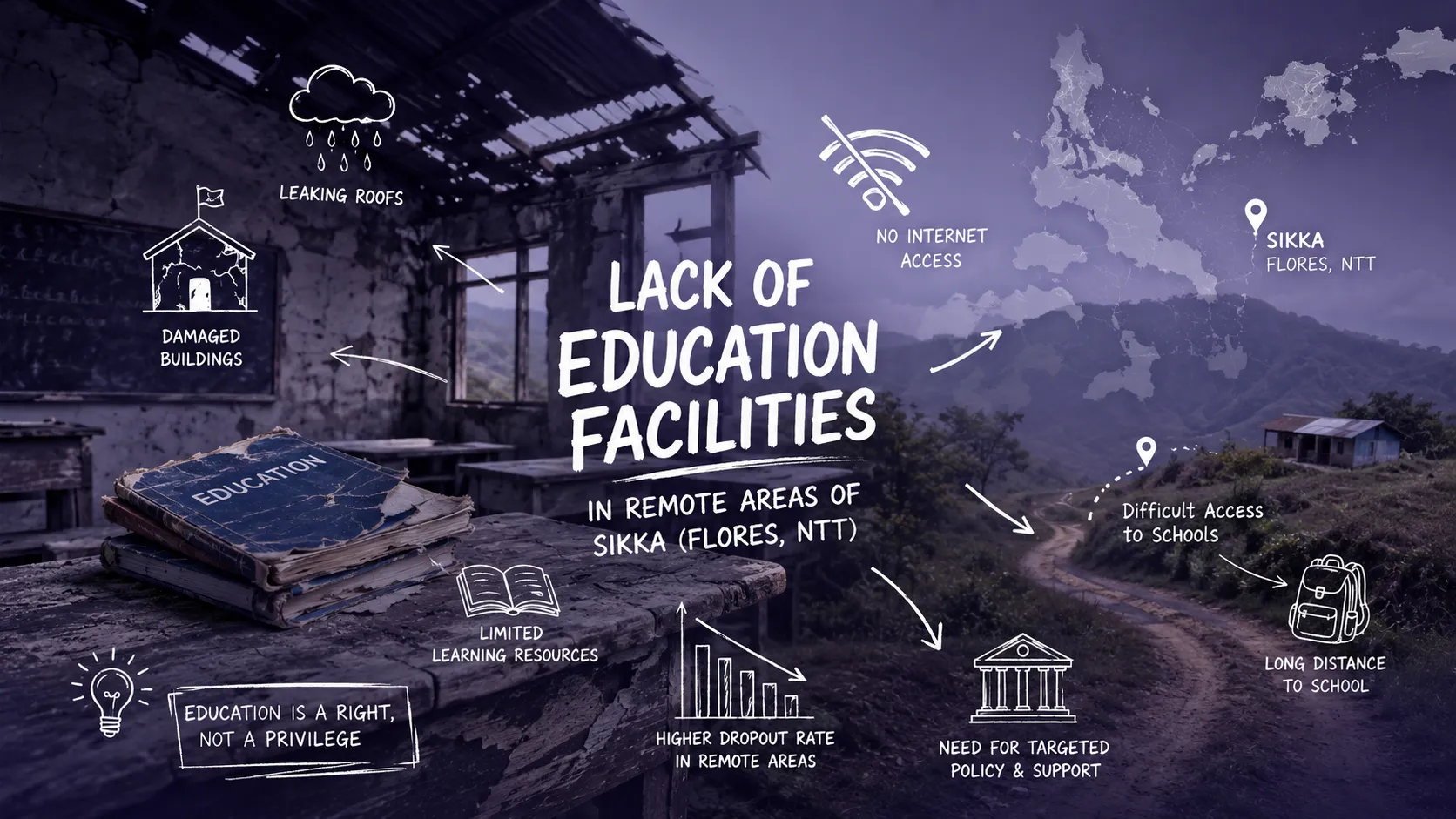

Education is everyone’s right and plays a significant role in improving the quality of life. Unfortunately, many areas in Indonesia still lack adequate access to education. In remote areas like Sikka (Flores, East Nusa Tenggara), limited educational facilities remain a serious and concerning problem.
Recent data shows that many schools in remote areas of Indonesia still lack basic facilities, such as adequate classrooms, textbooks, and even electricity and internet access.
In areas like Sikka, this situation is not just a common occurrence but a daily reality for students. Many must study in dilapidated classrooms, use makeshift desks, or walk for kilometers just to attend school.
This situation is truly heartbreaking, especially in this increasingly advanced era, when technology and education should be accessible to everyone without exception.
In my opinion, the lack of educational facilities in remote areas like Sikka is a serious problem that requires immediate attention. This situation not only hinders the teaching and learning process but also widens the gap in educational quality between remote and urban areas.
Inadequate Educational Facilities
Educational facilities in remote areas like Sikka remain inadequate. Many schools have damaged buildings, with leaking roofs, cracked walls, and a shortage of desks and chairs for students.
In addition, limited textbooks and learning aids hinder the learning process.
Also Read: Nasib Tepian Negeri Terengah-Engah di Tengah Pacuan Kurikulum Merdeka
Research also shows that an uncomfortable learning environment can reduce students’ concentration and motivation, ultimately affecting their academic performance.
Difficult Access to Schools
Difficult access to schools further worsens the educational situation in these areas. According to various education reports, many students in rural and remote areas, including in East Nusa Tenggara, must walk more than 3–5 kilometers each day just to get to school.
In fact, the elementary school dropout rate in remote areas is still higher than in urban areas. This situation is further exacerbated by limited transportation and inadequate roads. These facts clearly demonstrate that educational facilities and access remain severely lacking.
Also Read: Ketimpangan Pendidikan: Mengapa Keadilan Sosial di Indonesia Masih Sulit Terwujud?
Government Efforts and Existing Challenges
Critics argue that the government has made various efforts to improve education in remote areas, such as allocating funds for school construction and educational facilities. It is true that these programs exist.
However, in reality, their implementation is often uneven and does not fully reach the most remote areas.
Many schools in areas like Sikka have yet to experience these improvements. This suggests that more targeted and consistent measures are needed to create meaningful change.
Conclusion
In conclusion, the lack of educational facilities in remote areas like Sikka is a serious problem that cannot be ignored. This situation not only hinders students’ learning but also widens the educational gap in Indonesia.
Therefore, collaboration between the government, the private sector, and the community is needed to ensure that everyone receives a decent education.
Concrete steps, such as repairing damaged school buildings, providing sufficient learning resources, and ensuring the availability of qualified teaching staff, must be prioritized.
Ultimately, education is not a privilege for a select few but a fundamental right that should be enjoyed equally by all.

Author: Melati Suryanin Tiyas (25110001)
Student of the Bachelor of Applied Science (D4) Program in Public Sector Accounting, Harkat Negeri University
Editor: Nilam Indahsari
Languange Editor: Rahmat Al Kafi

⚡ Baca Lebih Cepat Artikel MMI di Ponsel Anda!
Ikuti Channel WhatsApp
Media Mahasiswa Indonesia (MMI):
KLIK DI SINI