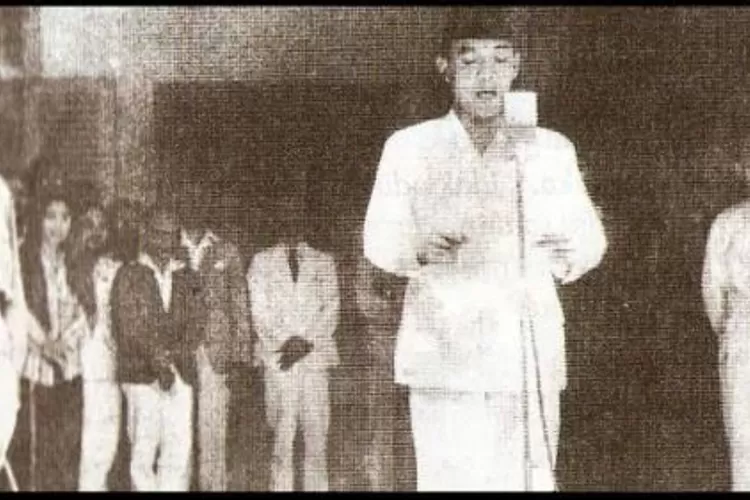

President Soekarno’s call to “Never forget history,” known by the acronym JAS MERAH, is more than just a patriotic slogan. It serves as an eternal warning to the Indonesian nation against losing its direction amid the currents of changing times. However, in the fast-paced and distraction-filled digital era, history is becoming a commodity that is easily reworked, not for educational purposes, but for political interests and influence.
The national history rewriting project initiated by the Ministry of Culture in 2025 has sparked widespread controversy. Involving over 100 writers and 20 editors, the project aims to compile a narrative that is more “Indonesia-centric.” However, criticism has arisen from various academic and activist circles.
GMNI East Java, for instance, assessed that the circulating draft contains manipulation and the deletion of important events, and is allegedly part of a desoekarnoization agenda.
Yanuar Nugroho, founder of the NALAR Institute, stated that the rewriting of history is not neutral academic work, but rather a political act that risks eliminating the space for historical contestation. When history is reduced to a single narrative, the collective memory of the nation is threatened with control.
In the digital era, social media has become the primary arena for the dissemination of historical information. Platforms such as TikTok, Instagram, and YouTube are now filled with historical content packaged visually and emotionally, yet often without verification. A study from Sebelas Maret University indicates that social media plays a dual role: as a space for education while simultaneously being a fertile ground for historical distortion⁽⁴⁾.
For example, narratives concerning the 1965 events or the 1998 Reformasi are often simplified into viral content that ignores complexity and context. Furthermore, historical hoaxes, such as the glorification of specific figures or the erasure of marginalized groups’ roles, are increasingly rampant and difficult to contain.
The younger generation, growing up with instant access to information, is ironically the most vulnerable group to historical manipulation. They are more familiar with video clips and memes than with archives and books. When algorithms determine what is worthy of viewing, history is curated by the logic of popularity, not truth.
The Communication Forum for History-Caring Communities (FKMPS) has even warned that a new, systematic historical distortion is occurring, and if left unchecked, it will form a generation that has lost its root identity.
Amidst the threat of oblivion and the repolishing of history, the spirit of JAS MERAH must be rekindled. This is not merely an invitation to remember the past, but to defend the integrity of history as the nation’s mirror.
The public, especially the younger generation, needs to be encouraged to read primary sources, engage in cross-perspective discussions, and reject the single narratives presented by power or algorithms. History does not belong to the state, nor to social media, nor to the political elite. It belongs to the people who experienced it, and it must be preserved to remain clear, whole, and just.
Author: Hanum Putri Adzimatinur
Public Sector Accounting Student, Harkat Negeri Tegal University
Lecturer: Mohammad Sofyan
Editor: Salwa Alifah Yusrina
Bahasa: Rahmat Al Kafi
⚡ Baca Lebih Cepat Artikel MMI di Ponsel Anda!
Ikuti Channel WhatsApp
Media Mahasiswa Indonesia (MMI):
KLIK DI SINI