

In the past two decades, South Korean popular culture has successfully transcended national boundaries and become a global phenomenon known as Hallyu, or the Korean Wave.
From K-pop music and drama series to feature films, Korea sells not only entertainment but also a modern, gentle, and emotional cultural image.
One of the most prominent elements in this cultural product is the image of the romantic male, a gentle, caring, and self-sacrificing figure for love. This image is consistently present in various popular works such as My Sassy Girl (2001) and Crash Landing on You (2019).
In these dramas and films, Korean men are portrayed not as harsh, dominant figures, but as men who know how to treat women with respect and affection.
This image has become a major attraction for international audiences, especially women, who see it as a new form of masculinity, strong but sensitive, assertive but caring.
However, behind this ideal image lies an irony that cannot be ignored. South Korea is known for having one of the highest gender disparities among developed nations.
Although Korean women have made significant progress in education and careers, the patriarchal culture remains strong.
Numerous studies and surveys show that Korean men tend to hold conservative views on gender roles, and in recent years, an anti-feminist movement has emerged among young men.
This raises an important question: is the image of the romantic male in Korean cinema truly a cultural representation, or is it simply part of a soft power construct intended to project an ideal image of Korea to the world?
The Romantic Male Imagination and Global Appeal
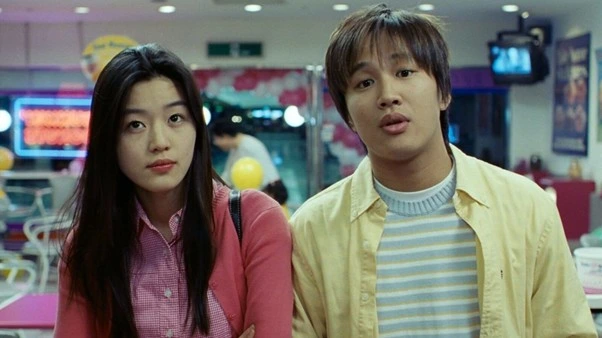
Korea is indeed very adept at creating narratives about love and gender roles in cinema. My Sassy Girl, for example, features a male character (played by Cha Tae-hyun) who is patient and loyal to his impulsive and temperamental lover.
This film reverses classic gender stereotypes, where women are depicted as dominant, while men are passive. But behind this reversal, there is still a hidden message that ultimately, men remain the figures who stabilize relationships, who “save” women from their emotions and fragility.
Then, two decades later, Crash Landing on You repeats a similar pattern in a more modern and global version. Ri Jeong-hyuk (played by Hyun Bin) is a North Korean soldier who is firm but gentle, compassionate but brave.
He protects Yoon Se-ri (Son Ye-jin), the heiress of a large South Korean company, with extraordinary loyalty. The romance in this drama is not only about personal relationships, but also symbolizes the political reconciliation of love across ideological boundaries.
In a subtle way, Korean cinema teaches global audiences to see Korea as a warm, humane, and loving nation. This representation of men is very effective in creating emotional branding.
The world fell in love not only with the characters, but also with the cultural values they represent, including loyalty, empathy, and sincerity.
This image has been incredibly successful in softening Korea’s image in the eyes of the world and simultaneously serving as a powerful tool for cultural diplomacy.
Soft Power and Korean Cultural Strategy
The concept of soft power, introduced by Joseph Nye, explains how a country can influence another country without coercion, but through the appeal of culture, values, and policies.
South Korea is the most successful example of this concept. The government actively supports cultural exports, from film and music to culinary and fashion, as part of its national diplomatic strategy.
The image of the romantic male in Korean cinema is part of that strategy. Through films and dramas, Korea presents the best version of itself: modern, sensitive, and respectful of women.
This image certainly differs from social reality, but in the world of soft power, perception is not the most important thing.
By portraying caring and loving men, Korean cinema has succeeded in building significant cultural capital. Audiences worldwide associate Korea with beautiful love stories, fashionable urban life, and warm family values.
The impact is very visible, such as increased tourism, soaring sales of cultural products, and even a dramatic increase in interest in learning the Korean language.
Korea is not just selling stories, but also a lifestyle. Thus, through its romantic cinema, they can build an image of Korean society as emotional, loyal, and relationship-oriented. In fact, this image is the result of neat cultural engineering and that is precisely where their soft power lies.
Baca Juga: Review Film A Man Called Otto
Romanticism As Soft Propaganda
While this may sound positive, this image of the romantic male can also be read as a form of soft propaganda. It doesn’t scream like political propaganda, but works through symbols, dialogue, and subtle gestures.
By portraying Korean men as ideal figures, Korean cinema masks less desirable aspects, such as gender inequality, social pressures on women, and a harsh work culture.
In Crash Landing on You, Yoon Se-ri is portrayed as a successful and independent woman, but throughout the story she remains in need of protection and support from men. The male character Ri Jeong-hyuk becomes the moral and emotional center of the story.
Thus, the love that is built actually reinforces the idea that the ideal relationship is one where the woman is ultimately “protected” by the man. This is a subtle form of patriarchy, not through domination, but through a seemingly romantic role of savior.
This image is very effective because it disguises power with tenderness. When men are portrayed as romantic and caring, patriarchal structures appear harmless, even though they operate in more subtle ways.
This is why many observers call Korean romantic cinema “soft propaganda,” persuading through feelings rather than arguments. The image of the romantic male in Korean cinema is not simply an aesthetic construct, but a well-thought-out cultural strategy.
It is a crucial part of South Korea’s soft power, where power operates through emotion, not domination. By portraying compassionate and sensitive men, Korea has successfully cultivated a positive self-image in the eyes of the world, while simultaneously strengthening its global appeal.
However, on the other hand, this image can also be read as a form of cultural propaganda, as it presents an idealized version of Korean society that sometimes does not align with reality.
Behind the scenes, patriarchy persists, gender inequality persists, and feminist movements often face resistance.
Ultimately, the romantic male lead in Korean cinema is a paradox. It’s a symbol of love, but also a political tool, one that captivates the world, yet also makes many forget that behind every sweet story lies a careful cultural strategy and a clear national purpose.
Therein lies the true power of soft power: making influence feel like a feeling, soft and warm, and hard to resist.
Penulis: Adinda
Mahasiswa Prodi Ilmu Hubungan Internasional Universitas Sriwijaya UNSRI
Editor: Fifi Elvira
Bahasa: Rahmat Al Kafi
Reference
Elfving-Hwang, J. (2011). Gender, Globalization and Aesthetic Ideals in South Korea. Feminist Media Studies, 11(3), 295–310.
Park, H. S. (2020). South Korean cine-feminism on the move. Asian Journal of Women’s Studies, 26(4), 511–523. https://doi.org/10.1080/12259276.2020.1847759
Ab. Hamid, N., & Abdul Hamid, N. (2017). Prettiness as a shield: The romantic perpetuation of patriarchy through the representation of “pretty boys” in popular Korean dramas in Malaysia. Journal of Nusantara Studies, 2(2), 92–107.
Nye, J. S. (2004). Soft Power: The Means to Success in World Politics. PublicAffairs.
Leung, S. (2020). Crash Landing on You and the Politics of Korean Soft Power. Journal of Asian Cultural Studies, 12(2), 45–60.
Ministry of Gender Equality and Family (MOGEF). (2024). Gender equality policy and statistics in the Republic of Korea. Government of the Republic of Korea. https://www.mogef.go.kr/eng/lw/eng_lw_f002.do
UN Women. (2024). Republic of Korea: Gender data and statistics. United Nations Entity for Gender Equality and the Empowerment of Women. https://data.unwomen.org/country/republic-of-korea
Kim, H. (2024, March 19). The fight over gender equality in South Korea. Carnegie Endowment for International Peace. https://carnegieendowment.org/research/2024/03/the-fight-over-gender-equality-in-south-korea
The Korea Herald. (2025, January 15). South Korea’s gender equality index falls to all-time low. The Korea Herald. https://www.koreaherald.com/article/10467644
Ikuti berita terbaru Media Mahasiswa Indonesia di Google News

⚡ Baca Lebih Cepat Artikel MMI di Ponsel Anda!
Ikuti Channel WhatsApp
Media Mahasiswa Indonesia (MMI):
KLIK DI SINI