
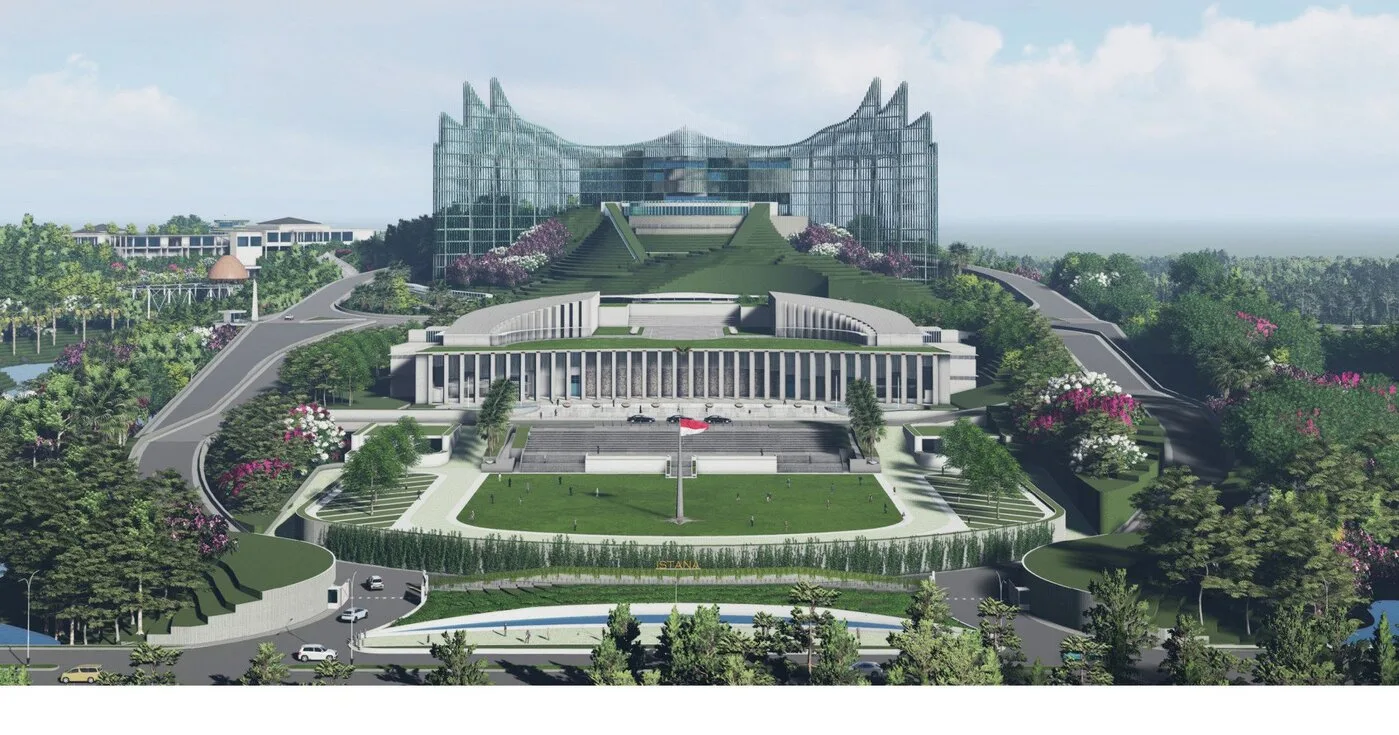

Lately, the development of Indonesia’s new capital, Nusantara (IKN), has once again come under the spotlight.
One of the British media outlets, The Guardian, described the project as “at risk of becoming a ghost city,” citing limited investor interest and uncertainty regarding its future.
This narrative quickly sparked public debate in Indonesia and fueled skepticism, as though the project had already failed.
However, I believe this view is overstated. IKN is not a failed project; rather, it represents a significant step toward building a more sustainable, equitable, and modern administrative center for Indonesia.
The rationale behind relocating the capital is rooted in the overwhelming burden Jakarta has shouldered for decades.
According to Statistics Indonesia (BPS), more than 56 percent of Indonesia’s population resides on the island of Java, which accounts for only about 6.7 percent of the country’s total land area.
This imbalance has led to stark disparities in economic development, infrastructure, and public services between Java and other regions.
Through IKN, the government seeks to promote more balanced national development while reducing Jakarta’s chronic congestion, worsening air pollution, and land subsidence the latter estimated to reach 3 to 11 centimeters per year, according to the Ministry of Public Works and Housing (PUPR).
It is true that IKN faces challenges, particularly related to funding and construction progress. The IKN Authority has reported investment commitments of approximately Rp255.02 trillion, while the project’s total estimated cost stands at around Rp466 trillion.
However, this gap does not inherently signify failure. Projects of this scale are typically developed in phases.
The government has secured collaboration with 42 national and international companies, and more than 70 percent of IKN’s core infrastructure, including main roads, civil servant housing, and the presidential palace area is currently under active construction.
This indicates visible, measurable progress despite the work still underway.
I do not fully agree with the assertion that IKN is destined to become a “ghost city.” A transformation of this magnitude naturally requires time, continuity, and patience.
Read More: Bullying: A Blurred Reflection of a Campus Lacking Empathy
Indonesia is in the process of shaping a new chapter in its national identity; therefore, early obstacles and slower phases of development should not be interpreted as failure.
While I disagree with the negative framing from foreign media, I also believe that such critiques should not be dismissed.
Instead, they can serve as constructive reminders for the government to remain transparent, responsive to feedback, and consistent in accelerating key development milestones rather than engaging in defensiveness.
Ultimately, the success of IKN should not be measured solely by the scale of its buildings or the grandeur of its design, but by its ability to become a livable, inclusive, and sustainable city for its residents.
If managed with consistency, accountability, and a commitment to public welfare, IKN has the potential to stand not merely as a symbol of ambition, but as a reflection of Indonesia’s vision for fair, forward-looking national development.
Writer: Devina Ramadhani Kalyanacitta
Student of Public Sector Accounting Program, Universitas Harkat Negeri
Editor: Siti Sajidah El-Zahra
Copy Editor: Rahmat Al Kafi
Ikuti berita terbaru Media Mahasiswa Indonesia di Google News

⚡ Baca Lebih Cepat Artikel MMI di Ponsel Anda!
Ikuti Channel WhatsApp
Media Mahasiswa Indonesia (MMI):
KLIK DI SINI