
Abstract
This goal This paper discusses the importance of local culture-based digital literacy as an innovative learning strategy in elementary schools. The background to this research stems from the low basic literacy skills of Indonesian students and the gradual erosion of local culture due to globalization.
This study aims to describe the implementation of digital literacy based on local culture. on SDN 26 Bancoh , as well as to examine the strategies, results, and challenges faced. This study used a descriptive qualitative approach . The research subjects included the principal, teachers, students, and parents, selected using purposive sampling . Data were collected through observation, in-depth interviews, and documentation , and analyzed using an interactive model.
Research findings indicate that integrating digital literacy with local culture improves students’ understanding of technology while fostering a sense of pride in local wisdom. Learning strategies such as project-based activities , the use of digital media (videos, e-books, digital posters ) , and community collaboration have proven effective in enhancing students’ motivation and 21st-century skills—especially critical thinking, creativity, communication, and collaboration . The main obstacles identified were limited facilities, varying teacher competencies, and suboptimal parental support.
This study concludes that local culture-based digital literacy is a relevant and contextual approach to developing students’ 21st-century competencies without neglecting cultural identity. This implies the need for ongoing support from schools, teachers, parents, and local governments in terms of facilities, teacher capacity development, and community engagement so that digital literacy rooted in local culture can be implemented more widely and sustainably.
Keywords: Digital literacy; local culture; elementary school; SDN 26 Bancoh.
Introduction
The rapid development of information and communication technology in the 21st century has brought significant changes to various aspects of life, including education. The digital revolution has transformed the way humans access, process, and distribute information (Zaki Zikra Sahputra, 2023) . Children from an early age now live side by side with gadgets, the internet, and various digital applications. This demands new skills known as digital literacy for school teachers. (Roosie Setiawan, 2019) . Promoting the “Digital Literacy Movement” is defined as a movement to motivate, mobilize, and foster digital “literacy” (Diputra et al., 2020) . Digital literacy is not merely the technical ability to operate devices, but also includes the ability to understand, evaluate, manage, and produce digital information critically, ethically, and responsibly (Wikipedia Contributor, 2018) . Therefore, digital literacy learning needs to be implemented because it is a practical solution to build digital literacy competencies for teachers and students, in order to form human resources with character in advancing education in Indonesia. (Asari et al., 2019)
Basic education is a crucial foundation for instilling digital literacy skills. At this level, students are at a stage of rapid cognitive and social development. Therefore, teachers need to introduce digital literacy skills in a way that is contextual, enjoyable, and relevant to students’ daily lives. One approach is to integrate digital literacy with local culture. This integration is crucial for introducing local culture to students from an early age to prevent it from being eroded by the currents of globalization. (Yudiati et al., 2024) A
The phenomenon of local cultural erosion is fading as understanding of values declines (Nurfitriani et al., 2022) . Local culture itself plays a strategic role in shaping national character. Values embedded within local culture, such as mutual cooperation, tolerance, environmental wisdom, and respect for customs, constitute a valuable legacy. However, in the current era of globalization, many young people are beginning to lose their connection to local culture due to increased exposure to global culture through digital media (Polino, 2022) . This is where the importance of schools providing learning that bridges the gap between the digital world and local cultural preservation becomes crucial.
This school developed a local culture-based digital literacy program as a strategy to instill a love of local culture in students while improving their digital skills. (Kusni et al., 2021) Through the use of interactive media, videos, e-books, and digital projects that highlight local cultural themes, students are encouraged to recognize, understand, and preserve local wisdom in an engaging and contemporary manner.
This also aligns with the Independent Learning policy, which emphasizes the importance of learning relevant to students’ real lives. Integrating digital literacy with local culture not only helps students understand cultural values (Zakaria, 2022) but also trains them to use technology for positive and productive purposes. Thus, digital literacy based on local culture can be a strategy for developing 21st-century competencies, such as critical thinking, creativity, collaboration, and communication, without losing national identity.
Several researchers have shown that local culture-based learning can improve student motivation, conceptual understanding, and character. However, few studies have examined in depth how digital literacy can be integrated with local culture in elementary schools, especially in rural areas like Bancoh. Yet, this approach has great potential to connect students with their surroundings while equipping them with digital skills.
Based on this background, this study aims to describe the implementation of local culture-based digital literacy in elementary schools. The study focuses on the strategies employed by the school, the media used, the roles of teachers and students, the outcomes achieved, and the challenges encountered. The results of this study are expected to contribute to the development of learning models that integrate digital literacy with local cultural preservation and serve as a reference for other schools in developing similar practices (Khozaini & Mundiri, 2024).
Baca Juga: Google in Education: A Case Study of Illiteracy in West Kalimantan
Study Method
1. Types and Approaches Study
This research approach uses a qualitative descriptive approach in the form of collecting problems and drawing conclusions based on phenomena based on the results of interviews, observations, and documentation (Aimang, 2022) . Qualitative research aims to explore social phenomena in a real context, so it is highly relevant to this research (Sutarto et al., 2021) . By using a descriptive approach, the researcher shows that the integration of digital literacy with local culture has been carried out through curriculum development, technology utilization, and creative activities. based on local wisdom. However, its implementation still faces challenges such as limited facilities, limited digital competency, and the need for stronger external support. Therefore, a sustainable strategy is needed through teacher training, infrastructure provision, and collaboration with cultural communities to realize digital literacy rooted in local identity.
2. Research Location
This study was conducted at an elementary school located in a rural area with strong socio-cultural characteristics (Nulis, 2023) . This school was intentionally selected because it had developed a digital literacy program based on local culture through various learning activities. Furthermore, the elementary school’s students primarily come from families with limited digital literacy, making the implementation of this program interesting to study.
3. Research Subjects and Informants
Students and educators at SDN 26 Bancoh is subject study This . Purposive sampling method is used For choose informant study based on criteria following : Teachers are involved direct in planning and implementation learning based digital literacy and culture local.Students from class II to class V follows activities that focus on digital literacy because ability base literacy Already start develop at the level this , so that student more Ready For start digital learning . Head school as guarantor responsible answer on policy level school .
The research informants consisted of one principal, five teachers, and 20 students. The researchers also involved parents as additional informants to understand their perceptions of the local culture-based digital literacy program.
4. Data collection technique
Research data was collected using a number of techniques, namely:
Observation
Researchers conducted direct observations of classroom learning activities, both inside and outside the classroom, related to local culture-based digital literacy. These observations were used to obtain a realistic picture of student activities, teacher-student interactions, and digital media utilization (Sitoresmi, 2025) .
In-depth interview
Conducted with the principal, teachers, students, and parents to gather information related to program planning, implementation, results, and challenges. Interviews were semi-structured to maintain focus while still allowing informants to share their stories freely (Literasiguru, 2024) .
Documentation
Researchers collect documents in the form of Lesson Implementation Plans (RPP), photos or videos of activities, and student work. This documentation helps strengthen data obtained from observations and interviews (Lapin, 2006) .
5. Research Instruments
Research conducted by collecting data , the instruments used is observation, interviews, and documentation. Analyze the data that has been obtained , then compile report research result (Yulianti et al., 2023) . This instrument is designed based on the research focus so that the data obtained is more systematic and meets the needs.
6. Data Analysis Techniques
The data obtained were analyzed using the Miles and Huberman interactive model (Miles, 2014) which includes three stages, namely:
Data reduction
The process of selecting, focusing, simplifying, and organizing raw data into specific categories.
Data presentation
Arrange the data in narrative form, tables, or charts to make it easier to understand.
Conclusion of withdrawal
The analysis process is continuous from the beginning of data collection to the end of the research.
7. Data Validity Test
Triangulation various technique used For inspect data validity . This including source triangulation like compare data about teachers, students , principals school , and parents.Technique triangulation covering compare results observation , interviews , and documentation. And time triangulation , collecting data at different times For see information consistency.
Baca Juga: Bahasa Inggris di Era Digital: Dari TikTok ke Ruang Kelas
Research result
1. General description of SDN 26 Bancoh
SDN 26 Bancoh is a public elementary school in a rural area with strong socio-cultural characteristics. The majority of its students come from farming and fishing families with varying parental education levels. The school’s technological facilities are relatively limited, but in recent years, the school has begun utilizing simple digital devices such as laptops, projectors, and internet access.
This situation presents schools with a dual challenge: on the one hand, they want to improve students’ digital literacy skills, but on the other, they want to maintain the sustainability of local cultural values, which are starting to be marginalized due to the influx of popular culture through digital media. Therefore, schools develop learning programs that integrate digital literacy with local culture.
2. Implementation of Digital Literacy Based on Local Culture
Local culture-based digital literacy is the ability to understand, use, and create digital information connected to local wisdom. The goal is to instill cultural values while honing students’ abilities to utilize information technology creatively, ethically, and productively.
Strengthening digital literacy needs to be synergized with the preservation of local cultural values so that students are not separated from its cultural roots. So teachers can integrating local culture-based digital literacy into learning activities.
3. Implementation Strategy at SDN 26 Bancoh
Implementation at SDN 26 Bancoh was carried out through several main strategies:
Integration in the Curriculum
Teachers integrate local content culture — such as people’s stories,
traditional games and regional arts — for subject lessons.
For example :
- In Indonesian language lessons, students create digital stories about local legends.
- In Arts and Culture class, students make video documentation of traditional dances. use gadget school.
Utilization of Technology
Schools provide access to digital devices (laptops, tablets, or gadgets)
To support learning, teachers guide students in finding local cultural information via the internet, then verify truth information.
Digital Literacy Project
Students involved in projects such as:
Digital literacy-based learning activities can be carried out through the creation of
digital culture posters, school blog management containing articles and
documentation of local community traditions, as well as collaboration with community leaders
in producing educational content based on local culture.
Involvement of the surrounding community
School Works the same as parents and local cultural figures For
enrich the teaching materials. Local resource persons are invited to provide
views on the values of local customs, traditions and languages.
4. Implementation Results
The implementation of local culture-based digital literacy at SDN 26 Bancoh shows positive results:
The implementation of digital literacy based on local culture can increase students’ interest in digital reading and writing, strengthen their cultural identity in the school environment, develop critical and creative thinking skills through digital content creation, and build more harmonious relationships between schools and the community through collaborative activities .
5. Internal Implementation Constraints
Even though it shows positive results, there are several obstacles faced.
schools in implementing this program, namely:
Limited Technology Facilities . The number of digital devices is still limited so that
students must take turns use it. In addition, the internet network is often not
stable.
Diverse Teacher Skills .
Not all teachers have the same digital literacy skills.
Some teachers still have difficulty in using it digital applications so necessary
further training. Inadequate parental support , some parents
not yet accustomed to using technology in learning, so that No
Enough support students when studying from House .
Limited Study Time
Digital literacy integration activities often require more time, while the dense curriculum means teachers have to organize strategies so that everyone fixed material sent.
Discussion
Result of in -depth interviews through approach culture local activities carried out in the field with various parties in the environment school base can produce a number of discussion important things to do remembered by all circles.Data observation For used as material study about literacy culture local on the spot This like skills students, responses teacher, person old student or figure public local as well as facilities and infrastructure need more support optimal.Although succeed introduce culture local local, there is a number of findings obtained as material study :
Findings data
| Aspect | Positive Findings | Obstacle |
| Student Skills | Able to create digital posters, summaries of people’s stories, simple videos | Skills are still basic, need further training |
| Teacher Response | Enthusiastic, feel helped, learning is more interesting | Some teachers have difficulty using digital applications. |
| Student Response | Enthusiastic, more proud of local culture | Limited devices |
| Parental Support | There are those who actively help find cultural information. | There are still many who do not understand digital literacy |
| School Facilities | The existence of laptops, projectors, school internet | Limited quantity, unstable network |
Things to pay attention to in understanding local cultural digital literacy in schools the that is :
A. Basic Concept of the problem of erosion of local cultural values in the digital era
1. Digital Literacy
Digital literacy designs are increasingly developing along with the rapid development of information technology. The term digital literacy was first used Digital literacy It was introduced as the ability to understand and use information from various digital sources. As it has evolved, digital literacy has become understood not only as a technical skill but also encompasses cognitive, social, and ethical aspects. Hague and Payton (2010) emphasize that digital literacy includes: the ability to access, analyze, evaluate, and create (Payton & Hague, 2010).
In the context of education, digital literacy is one of the 21st-century competencies that students must possess. UNESCO (2018) states that digital literacy helps students become critical, creative, and responsible global citizens. The Ministry of Education, Culture, Research, and Technology of the Republic of Indonesia also emphasizes the importance of digital literacy in its National Literacy Movement (GLN) program. This demonstrates that digital literacy has become a strategic national, global, and international agenda.
For elementary school students, digital literacy extends beyond the technical ability to operate devices, but also includes developing a habit of using technology for positive purposes. For example, using the internet to search for useful information, use educational apps, or facilitate digital-based tasks. Thus, digital literacy can be a tool for developing lifelong learning skills.
2. Local Culture
Local culture refers to the values, norms, customs, language, art, and local wisdom that develop in a particular region. According to Koentjaraningrat (2009), culture is the entire system of ideas, actions, and human works in social life that are made human property through a learning process. Local culture itself plays a vital role in strengthening community identity, fostering a sense of togetherness, and preserving traditions.
In Indonesia, local cultures are highly diverse, reflecting the geographic, ethnic, and historical characteristics of each region. This diversity is a national treasure that must be preserved. Unfortunately, globalization and the penetration of foreign cultures often displace the role of local culture, especially among the younger generation. Therefore, education plays a strategic role in introducing, preserving, and instilling local cultural values from an early age.
Local culture-based learning has been proven to increase student interest in learning. This is because learning material that is closely related to students’ daily lives is easier to understand. Furthermore, local culture-based learning also supports character education, as it contains moral, social, and spiritual values relevant to life.
3. Integration of Digital Literacy and Local Culture
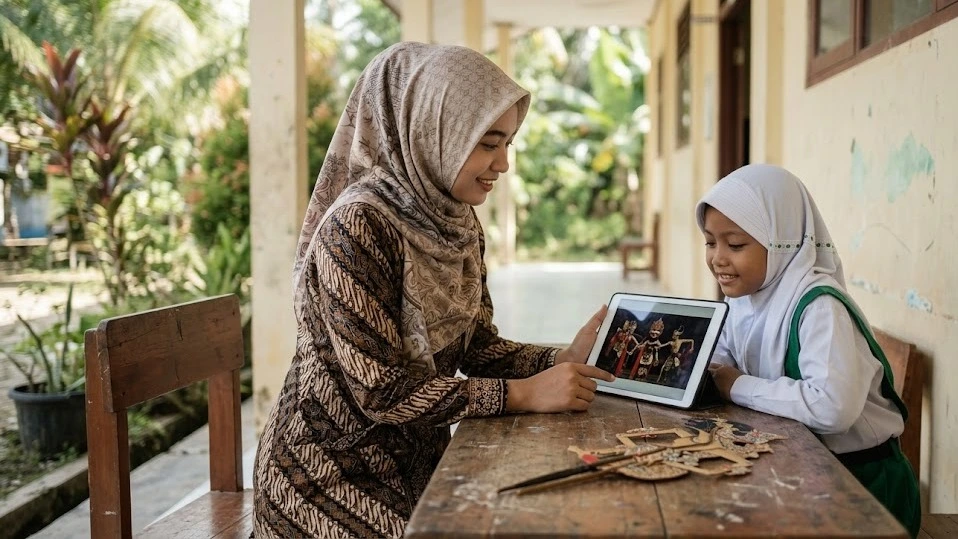
Integrating digital literacy with local culture is an innovative approach in primary education. Essentially, students can be introduced to local culture through digital media, for example, by watching videos about regional arts, creating digital presentations about ceremonial customs, or writing folktales using word processing applications (Kuntari, 2023) . With this method, students not only learn about local culture but also practice digital skills.
Integrating digital literacy with local culture can enhance learning appeal, enrich learning experiences, and strengthen students’ cultural identity (Arifin, 2023) . Teachers act as facilitators, guiding technology use to ensure it remains grounded in cultural values (Zheng, 2025) . This is crucial so that students are not merely passive users of technology but are also able to produce digital works of cultural value.
At the elementary school level, this integration can be achieved through various learning models, such as project-based learning (PjBL), thematic learning, or blended learning. For example, students might be asked to create a simple documentary video about a traditional regional game or a digital poster about regional cuisine. In this way, learning not only improves digital skills but also fosters a sense of pride in regional culture.
4. Studies According to Experts
Several studies have examined the relationship between digital literacy and local culture in education. Research conducted by Arifin shows that the use of digital media in local culture-based learning can increase student motivation and participation (Arifin, 2023). Another study by Lutfiah confirms that integrating folklore with digital media can improve students’ literacy skills in schools (Lufiah et al., 2022).
International studies also support these findings. For example, research by ( Livingstone & Sefton-Green, 2016) in the UK shows that digital literacy integrated with local cultural contexts can strengthen students’ identities and increase their participation in learning. Similarly, a study by (Farisal et al., 2024) emphasizes that while digital media offers significant opportunities in reducing cultural gaps, its success also requires a careful and inclusive approach to ensure a diversity of voices and perspectives in digital spaces. The use of digital media must always be linked to students’ cultural and social contexts to be more meaningful.
However, while numerous studies have examined digital literacy and local culture separately, relatively few have explicitly linked the two in the context of rural schools. Therefore, this study at SDN 26 Bancoh makes an important contribution in providing a concrete illustration of how digital literacy can be integrated with local culture in a rural school environment.
Baca Juga: Civic and Political Education Combats Digital Disinformation
B. Digital Literacy as a 21st Century Skill
Research at SDN 26 Bancoh shows that digital literacy can be contextually integrated with local culture. This aligns with the concept of digital literacy, which is the ability to understand and use information in various formats from digital sources. In the era of globalization, this ability is part of 21st-century skills, encompassing the 4Cs (critical thinking, creativity, collaboration, and communication).
Through digital projects based on local culture, students at SDN 26 Bancoh not only learn to utilize technology but also develop cultural literacy, creativity, and innovation, as well as critical thinking skills, intelligence, and excellence in governance literacy. For example, when creating a digital poster about traditional food, students not only copy information but also select images, write repetitive descriptions, and create engaging presentations. This process fosters awareness that technology is not just a tool for entertainment, but also a learning medium.
C. The Contribution of Local Culture to Digital Literacy Learning
The integration of local culture into digital literacy has demonstrated a significant contribution to strengthening student identity. This research supports the findings of (Lufiah et al., 2022) that local culture-based learning can increase learning motivation and foster students’ love for local wisdom.
At SDN 26 Bancoh, local culture serves as a primary learning resource. Teachers show videos of regional dances, traditional games, and folktales, which students then process into digital summaries. This method not only trains students to access and process digital information but also to understand the noble values of their culture. This is crucial to prevent the identity crises often experienced by young people due to the dominance of global culture.
Furthermore, strengthening local culture through digital literacy helps schools fulfill their character education function. For example, when students write folktales in e-book form, they learn moral values such as mutual cooperation, hard work, and honesty (Kusni et al., 2021) . Thus, digital literacy serves not only to improve technical skills but also as a means of culturally based character education (Junaidi et al., 2024) .
D. Challenges of Implementing Digital Literacy in Elementary Schools
Although the study results show positive impacts, the challenges faced have not been overcome. One major challenge is limited facilities. This is consistent with a report (UNESCO, 2011) , which stated that the digital divide remains a major obstacle in rural schools. Limited devices and unstable internet connections reduce the effectiveness of digital literacy programs.
Another challenge is the diversity of teacher skills. Some teachers are still limited in their ability to operate digital applications, thus not maximizing their use of technology. This situation aligns with research by Khan (2020), which emphasizes the need for ongoing training for teachers to adapt to developments (Khan, 2020) .
From a parental perspective, support is still suboptimal. Many parents are unfamiliar with using technology in learning, and some even worry that gadget use will lead to addiction in their children. This situation requires outreach and education for parents about the importance of digital literacy as a foundation for their children’s future.
E. Strategy to Overcome Obstacles
To overcome these obstacles, several strategies can be applied:
1. Strengthening School Infrastructure
Schools need to collaborate with the government and the private sector to improve technology facilities. Corporate social responsibility (CSR) programs can be one solution for providing digital devices.
2. Improving Teacher Competence
Ongoing teacher training must be a priority. This training should focus not only on technical skills but also on pedagogical strategies for leveraging technology to strengthen culturally-based learning.
3. Parental Involvement
Schools can hold short workshops for parents on digital literacy. This way, parents can understand how to support their children in using technology wisely.
4. Utilization of Local Electricity Resources
Local culture can be continuously developed as contextual teaching materials. With this method, teachers no longer have to rely solely on the internet for material, but can instead utilize cultural documentation from the surrounding community.
F. Comparison with Previous Research
The findings of this study align with Saputra’s (2019) research, which showed that integrating local culture into digital literacy improves student motivation and learning outcomes. However, the study at SDN 26 Bancoh is unique because it was conducted in a rural area with limited facilities. This strengthens the argument that digital literacy is not limited to urban schools but can also be implemented in rural schools with certain adaptations.
This study also aligns with Warsihna’s (2021) findings, which emphasize the importance of Digital Citizenship Education in elementary schools. By linking digital literacy to local culture, students not only become smart technology users but also develop a strong sense of identity as part of the community’s culture (Nurul Mu’minin et al., 2023).
Thus, this discussion confirms that local culture-based digital literacy is not only an innovative strategy but also an urgent need to prepare the younger generation for the digital era without losing their cultural identity (Arifin, 2023).
Baca Juga: Miskinnya Literasi Digital di Era Milenial
Conclusions and Implications
Conclusion
Based on results research, study about local culture based on digital literacy in schools base through approach culture local , showing that the integration between digital technology and local wisdom can give positive results , activities literacy based culture local start known by the residents schools and their surroundings. Through active learning that utilizes digital media . So that students not only understand technology , but feel own culture origin from place his residence. Although thus various type constraint like inadequate internet facilities and infrastructure adequate, and internet usage is not appropriate use, teacher skills that are not evenly as well as parental support in activity learning not enough optimal, needs to be fixed later day.
Thus, local culture-based digital literacy has proven effective as an innovative learning strategy that not only improves digital skills, but also strengthens students’ character education and cultural identity.
Thank-you note
To the stakeholders of SDN 26 Bancoh who have provided space and time for the author to conduct research entitled “Digital Literacy of Local Culture: Getting to Know Local Culture at SDN 26 Bancoh.” This research was carried out not because of the greatness and strength of the researcher, but because of the grace of God Almighty, so that this research can be completed thanks to the support of all parties at SDN 26 Bancoh. The author also wants to express his gratitude to Prof. Dr. Touvan. Juni Samodra and Dr. Ricka Tesi Muskania, M.Pd., as lecturers in charge of the “SCIENTIFIC WRITING” course, who have guided the author so that he can complete it well despite facing extraordinary challenges. Learning from not knowing to knowing, from not understanding to understanding. And also to Senior Colleague Adir, S.Pd., M.Pd., who has provided direction and guidance in carrying out this research until it can finally be completed well. There is only one thing the author can say, “May God bless us all,” Amen.
Penulis: Susilowati (NIM:F2211251008)
Mahasiswa Pendidikan Guru Sekolah Dasar Universitas Tanjungpura
Dosen Pengampu: Prof. Dr. Touvan Juni Samodra
Editor: Ika Ayuni Lestari
Bahasa: Rahmat Al Kafi
Reference
Adhi, YP, Sulistianingsih, D., & Fidiyani, R. (2021). Intellectual Property Management Based on Local Wisdom to Strengthen a Culture of Literacy, Creativity, and Innovation. Indonesian Legal Services Journal , 4 (1), 18–30. https://doi.org/10.15294/jphi.v4i1.49934
Aimang, HA (2022). SURVEY OF LEARNING DURING THE COVID-19 PANDEMIC. AL-ILMI ISLAMIC EDUCATION JOURNAL , 5 (1). https://doi.org/10.32529/al-ilmi.v5i1.1608
Arifin, J. (2023). The Role of Digital Media in Preserving Indonesian Local Culture in the Era of Globalization. Jurnal Ilmiah Kanderang Tingang , 14 , 8–16. https://doi.org/10.37304/jikt.v14i1.202
Asari, A., Kurniawan, T., Ansor, S., & Bagus, NRP (2019). Digital Literacy Competence for Teachers and Students in Schools in Malang Regency. BIBLIOTIKA: Journal of Library and Information Studies , 3 (2).
Diputra, KS, Jayanta, NL, & Tristiantari, NKD (2020). Digital Literacy Movement for Elementary School Teachers. JCES (Journal of Character Education Society) , 3 (1).
Farisal, U., Widiyanarti, T., Sianturi, M., Ningrum, A., Fatimah, Y., Hastuti, P., Abdilah, A., & Desmonda, W. (2024). Connecting the World: The Role of Digital Media in Overcoming Cultural Divides. Indonesian Culture and Religion Issues , 1 , 10. https://doi.org/10.47134/diksima.v1i4.105
Junaidi, J., Raharjo, AB, Sahid, N., Sukanadi, IM, Wicaksana, DK, & Purnamasari, NPL (2024). Character Education Model in Wayang Kulit for Early Childhood. Harmonia: Journal of Arts Research and Education , 24 (2), 386–400. https://doi.org/10.15294/harmonia.v24i2.9625
Khan, A. (2020). Digital information literacy skills of Pakistani librarians: exploring supply-demand mismatches, adoption strategies and acquisition barriers. Digital Library Perspectives , 36 (2), 167–189. https://doi.org/10.1108/DLP-01-2020-0003
Khozaini, F. Al, & Mundiri, A. (2024). Realizing Digital Transformation Based on Local Wisdom; Smart Strategies Towards a Superior Governance System. JIIP – Scientific Journal of Educational Sciences , 7 (1). https://doi.org/10.54371/jiip.v7i1.3636
Kuntari, S. (2023). Utilization of Digital Media in Learning. Proceedings of the National Seminar of the Faculty of Tarbiyah and Teacher Training, IAIM Sinjai , 2 , 90–94. https://doi.org/10.47435/sentikjar.v2i0.1826
Kusni, K., Nasution, N., Suprijono, A., & Hendratno, H. (2021). DEVELOPMENT OF A CERTAIN EBOOK MEDIA BASED ON THE LOCAL WISDOM OF TANJUNG BUMI BATIK TO IMPROVE STUDENTS’ CHARACTER. Edueksos: Journal of Social & Economic Education , 10 (2). https://doi.org/10.24235/edueksos.v10i2.9237
Lapin, V. (2006). Hesitations at the door to an archive catalog (pp. 480–489). University of Michigan Press. https://www.scopus.com/inward/record.uri?eid=2-s2.0-84895033083&partnerID=40&md5=8b01c1295a00e7eb052ef325c44337cd
Literasiguru. (2024). Definition of Interview According to Experts . https://literasiguru.com/pengertian-hubungan-menurut-para-ahli/
Livingstone, S., & Sefton-Green, J. (2016). The Class: Living and Learning in the Digital Age . https://doi.org/10.18574/nyu/9781479884575.001.0001
Lufiah, S., Retno, RS, & Dewi, C. (2022). Development of a Digital Literacy Module Based on Madiun Local Culture to Increase Elementary School Students’ Learning Motivation. Proceedings of the Basic Scientific Conference , 3 .
Miles, M. at al. (2014). Qualitative Data Analysis: A Methods Sourcebook. In Sustainability (Switzerland) (Vol. 11, Number 1).
Nulis, H. (2023). Characteristics of Rural Areas Hobby Writing 03 Aug, 2023. Kukemo Education/caption , 1. https://www.kukemo.com/2023/08/karakteristik-wilayah-pedesaan.html
Nurfitriani, AI, Nurhasanah, E., & Hartati, D. (2022). LOCAL WISDOM IN A COLLECTION OF SHORT STORIES FROM THE EAST 1 2 3: SELECTION OF THE MAKASSAR INTERNATIONAL WRITERS FESTIVAL. JOURNAL OF EDUCATION AND DEVELOPMENT , 11 (1). https://doi.org/10.37081/ed.v11i1.4306
Nurul Mu’minin, M., Walhadi, D., & Kurniawati, W. (2023). Deep Learning Understanding of the Solar System: Exploration of Planets and Other Celestial Bodies. Indonesian Community Service Journal , 1 (2).
Payton, S., & Hague, C. (2010). publications digital literacy across the curriculum. Publications digital literacy across the curriculum , 1 (Digital literacy across the curriculum), 1–4. https://www.nfer.ac.uk/publications/digital-literacy-across-the-curriculum/
Polino, C. (2022). COVID-19: INFORMATIONAL INEQUALITY AND DEMOCRACY. Arbor , 198 (806). https://doi.org/10.3989/arbor.2022.806004
Roosie Setiawan, A. al. (2019). Elementary School Literacy Movement (A. al. Sofie Dewayani (ed.); 202 ed.). MINISTRY OF EDUCATION AND DASMEN. https://repository.kemendikdasmen.go.id/17586/1/Panduan GLS SD_Edition 2.pdf
Sitoresmi, AR (2025). The Purpose of Classroom Observation: A Complete Guide to Improving the Quality of Learning. liputan6.com , 1–9. https://www.liputan6.com/feeds/read/5903838/tujuan-observasi-kelas-panduan-lengkap-untuk-meningkatkan-kualitas-pembelajaran?page=9
Sutarto, S., Ahyansyah, A., Mawaddah, S., & Hastuti, ID (2021). Ethnomathematics: Exploring Mbojo Culture as a Resource for Learning Mathematics. JP2M (Journal of Mathematics Education and Learning) , 7 (1). https://doi.org/10.29100/jp2m.v7i1.2097
UNESCO. (2011). Digital literacy in education. Digital literacy in education , 393 (Policy brief), 12p. https://unesdoc.unesco.org/ark:/48223/pf0000214485
Wikipedia Contributor. (2018). Information and media literacy. In ss (Ed.), Wikipedia (2025 ed., Vol. 1, p. talk page). wikipedia. https://doi.org/1
Yudiati, R., Annisa, A., & Susilowati, AG (2024). THE IMPORTANCE OF INTRODUCING LOCAL CULTURE FROM AN EARLY AGE IN THE DIGITAL ERA. Rampa’ Naong Journal of Community Service , 2 (1). https://doi.org/10.24929/rn.v2i1.3289
Yulianti, Y., Dinie Anggraeni Dewi, & Dewi Wulan Sari. (2023). Analysis of early reading skills and difficulties in elementary school students. Journal of Education and Culture (JURDIKBUD) , 3 (2). https://doi.org/10.55606/jurdikbud.v3i2.1460
Zakaria, Z. (2022). INTEGRATION OF LOCAL WISDOM VALUES IN THEMATIC LEARNING IN ELEMENTARY SCHOOL/MI. Dirasah: Journal of Islamic Thought and Basic Education , 5 (2). https://doi.org/10.51476/dirasah.v5i2.405
Zaki Zikra Sahputra, M. (2023). 21st Century Technology: The Digital Revolution and Its Global Implications . https://selarasriau.com/detail/997/teknologi-abad-ke21-revolusi-digital-dan-implikasi-globalnya
Zheng, W. (2025). A Study on the Transformation of English Teachers’ Roles in Human-Machine Collaboration Modes. International Journal for Housing Science and Its Applications , 46 (4), 2448–2457. https://doi.org/10.70517/ijhsa464207

⚡ Baca Lebih Cepat Artikel MMI di Ponsel Anda!
Ikuti Channel WhatsApp
Media Mahasiswa Indonesia (MMI):
KLIK DI SINI